Ch. 24 - Benzene 2: Reactions Influenced by the Aromatic Ring
Mullins - Organic Chemistry: A Learner Centered Approach 1st Edition
Mullins1st EditionOrganic Chemistry: A Learner Centered ApproachISBN: 9780137566471당신이 사용하는 게 아니라요?교과서 변경
23장, 문제 26b

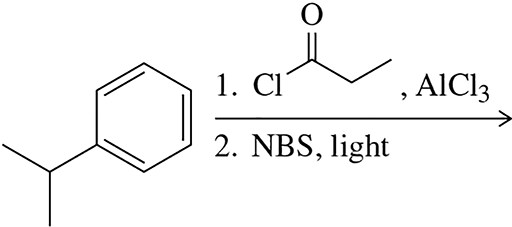
Predict the product(s) of each of the following multistep reactions.
(b) Chemical reaction diagram showing a multistep reaction with reagents and conditions for product prediction.

검증된 단계별 안내
1
Identify the first step as a Friedel-Crafts acylation reaction. The reactant is an isopropylbenzene (cumene) and the acylating agent is an acyl chloride in the presence of AlCl3, a Lewis acid catalyst.
In the Friedel-Crafts acylation, the acyl chloride reacts with AlCl3 to form an acylium ion, which is a strong electrophile. This electrophile will attack the aromatic ring of cumene, specifically at the para position relative to the isopropyl group due to steric and electronic effects.
After the acylation, the aromatic ring will have an acyl group (a ketone) attached at the para position. This completes the first step of the reaction.
The second step involves N-bromosuccinimide (NBS) in the presence of light, which is a condition for radical bromination. This step will selectively brominate the benzylic position of the alkyl chain attached to the aromatic ring.
The final product will have a bromine atom at the benzylic position of the isopropyl group, resulting from the radical bromination. The aromatic ring will also have the acyl group attached at the para position from the first step.

비슷한 문제에 대한 검증된 영상 답변:

이 영상 해법은 위 문제에 도움이 된다고 튜터들이 추천한 것입니다.

주요 개념

질문에 올바르게 답하기 위해 반드시 이해해야 하는 핵심 개념들은 다음과 같습니다.

Electrophilic Aromatic Substitution (EAS)

Electrophilic Aromatic Substitution is a fundamental reaction in organic chemistry where an electrophile replaces a hydrogen atom on an aromatic ring. In this reaction, the aromatic system donates electrons to the electrophile, forming a sigma complex, which then loses a proton to restore aromaticity. Understanding EAS is crucial for predicting products in reactions involving aromatic compounds, such as the one shown in the question.
추천 영상:
03:07
EAS Review

Reagents and Conditions

The choice of reagents and reaction conditions significantly influences the outcome of organic reactions. In the provided reaction, aluminum chloride (AlCl3) acts as a Lewis acid catalyst, facilitating the formation of the electrophile from the chlorinated compound. Additionally, N-bromosuccinimide (NBS) in the presence of light is used for bromination, which is a radical substitution process. Recognizing how these reagents interact is essential for predicting the final products.
추천 영상:
01:52
Reagents

Radical Mechanisms

Radical mechanisms involve reactions that proceed through the formation of free radicals, which are highly reactive species with unpaired electrons. In the second step of the reaction, NBS generates bromine radicals under light, which can abstract hydrogen atoms from the substrate, leading to the formation of brominated products. Understanding radical mechanisms is important for predicting the outcomes of reactions that involve radical intermediates.
추천 영상:
03:28
The mechanism of Radical Polymerization.