Ch. 25 - Amines: Structure, Reactions, and Synthesis
Mullins - Organic Chemistry: A Learner Centered Approach 1st Edition
Mullins1st EditionOrganic Chemistry: A Learner Centered ApproachISBN: 9780137566471당신이 사용하는 게 아니라요?교과서 변경
24장, 문제 52

Despite the amino group being an ortho/para director, nitration of aniline gives the meta isomer predominantly. Explain this result.

검증된 단계별 안내
1
Understand that the amino group (-NH2) is an ortho/para director due to its electron-donating nature, which typically increases electron density at the ortho and para positions of the benzene ring.
Recognize that nitration involves the introduction of a nitro group (-NO2) using a mixture of concentrated nitric acid (HNO3) and sulfuric acid (H2SO4), which generates the nitronium ion (NO2+), the active electrophile in the reaction.
Consider the reaction conditions: the strongly acidic environment protonates the amino group, converting it into an anilinium ion (-NH3+), which is a strong electron-withdrawing group.
Realize that the protonated amino group (-NH3+) is a meta director because it withdraws electron density from the ortho and para positions, making them less reactive towards electrophilic attack compared to the meta position.
Conclude that under these acidic conditions, the meta isomer is formed predominantly because the anilinium ion directs the incoming nitro group to the meta position, despite the original directing effects of the amino group.

비슷한 문제에 대한 검증된 영상 답변:

이 영상 해법은 위 문제에 도움이 된다고 튜터들이 추천한 것입니다.

주요 개념

질문에 올바르게 답하기 위해 반드시 이해해야 하는 핵심 개념들은 다음과 같습니다.

Amino Group as an Ortho/Para Director

The amino group (-NH2) is an electron-donating group that stabilizes the positive charge on the aromatic ring during electrophilic aromatic substitution. This stabilization occurs primarily at the ortho and para positions relative to the amino group, making these positions more reactive towards electrophiles like nitronium ions (NO2+).
추천 영상:
04:42
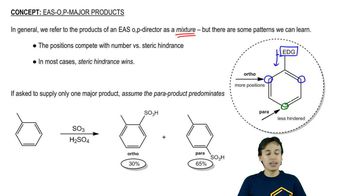
Ortho, Para major products

Electrophilic Aromatic Substitution Mechanism

Electrophilic aromatic substitution (EAS) is a fundamental reaction in organic chemistry where an electrophile replaces a hydrogen atom on an aromatic ring. In the case of aniline nitration, the nitronium ion generated from nitric acid and sulfuric acid acts as the electrophile. The reaction proceeds through the formation of a sigma complex, which can lead to different isomers depending on the stability of the intermediates.
추천 영상:
06:52
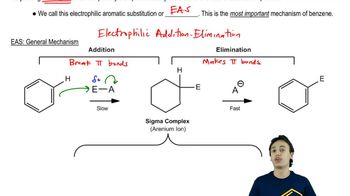
EAS General Mechanism

Steric Hindrance and Resonance Effects

While the amino group directs substitution to the ortho and para positions, steric hindrance can influence the outcome. In the case of aniline, the ortho position is hindered by the bulk of the amino group, making the meta position more favorable for substitution. Additionally, resonance effects can stabilize the meta product, leading to its predominance despite the ortho/para directing nature of the amino group.
추천 영상:
02:53
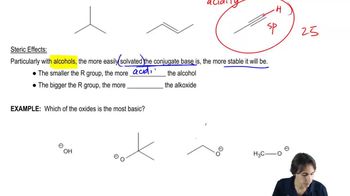
Understanding steric effects.