Ch. 27 - Carbohydrates, Nucleic Acids, and Lipids
Mullins - Organic Chemistry: A Learner Centered Approach 1st Edition
Mullins1st EditionOrganic Chemistry: A Learner Centered ApproachISBN: 9780137566471당신이 사용하는 게 아니라요?교과서 변경
26장, 문제 39a

In each of the disaccharides shown (a–c), (i) identify the reducing end of the sugar, (ii) tell what monosaccharides are used to make it, and (iii) tell what type of glycoside linkage is present.
(a) Structural representation of disaccharides showing sugar linkages and hydroxyl groups.

검증된 단계별 안내
1
Identify the reducing end of the sugar: Look for the anomeric carbon that is not involved in a glycosidic bond. In the given disaccharide, the rightmost sugar has a free anomeric carbon (the carbon attached to the OH group that is not involved in the glycosidic bond), indicating the reducing end.
Determine the monosaccharides: Examine the structure of each sugar unit. The left sugar unit is a glucose molecule, as indicated by the presence of an aldohexose structure with hydroxyl groups in the correct orientation. The right sugar unit is also a glucose molecule.
Identify the type of glycosidic linkage: Look at the oxygen bridge connecting the two sugar units. The linkage is between the anomeric carbon of the left glucose and the fourth carbon of the right glucose, indicating a 1→4 linkage. Since the anomeric carbon of the left glucose is in the beta configuration (the OH group is equatorial), the linkage is a β(1→4) glycosidic bond.
Verify the orientation of the glycosidic bond: Ensure that the glycosidic bond is consistent with the beta configuration by checking the orientation of the OH group on the anomeric carbon. In this case, the OH group is equatorial, confirming the beta linkage.
Summarize the findings: The disaccharide consists of two glucose units linked by a β(1→4) glycosidic bond, with the reducing end being the rightmost glucose unit.

비슷한 문제에 대한 검증된 영상 답변:

이 영상 해법은 위 문제에 도움이 된다고 튜터들이 추천한 것입니다.
영상 길이:
7m

주요 개념

질문에 올바르게 답하기 위해 반드시 이해해야 하는 핵심 개념들은 다음과 같습니다.

Reducing Sugars

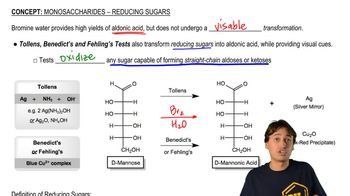
Reducing sugars are carbohydrates that can donate electrons to other molecules, typically due to the presence of a free aldehyde or ketone group. In disaccharides, the reducing end is the monosaccharide unit that retains this reactive group, allowing it to participate in redox reactions. Identifying the reducing end is crucial for understanding the reactivity and properties of the sugar.
추천 영상:
08:42
Reducing Sugars

Monosaccharide Composition

Disaccharides are formed by the condensation of two monosaccharides, which are the simplest form of carbohydrates. Understanding the specific monosaccharides involved in the formation of a disaccharide is essential for determining its structure and properties. Common examples include glucose, fructose, and galactose, which can combine in various ways to form different disaccharides.
추천 영상:
12:01
Monosaccharide

Glycosidic Linkage

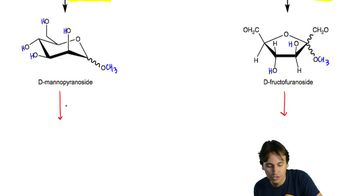
A glycosidic linkage is a covalent bond that connects two monosaccharides through a dehydration reaction, resulting in the formation of a disaccharide. The type of glycosidic linkage is defined by the specific carbon atoms involved in the bond and their orientation (alpha or beta). This linkage significantly influences the disaccharide's stability, digestibility, and biological function.
추천 영상:
12:17
Predict the structure of the glycoside products