Ch. 27 - Carbohydrates, Nucleic Acids, and Lipids
Mullins - Organic Chemistry: A Learner Centered Approach 1st Edition
Mullins1st EditionOrganic Chemistry: A Learner Centered ApproachISBN: 9780137566471당신이 사용하는 게 아니라요?교과서 변경
26장, 문제 22

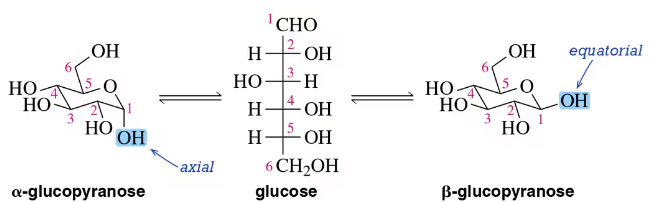
Suggest a mechanism by which α-d-glucopyranose is converted to β-d-glucopyranose in acid. [See Figure 27.18.]
Diagram illustrating the conversion of α-d-glucopyranose to β-d-glucopyranose, highlighting axial and equatorial positions of hydroxyl groups.

검증된 단계별 안내
1
Identify the starting and ending structures: α-d-glucopyranose and β-d-glucopyranose. Notice that the difference is the position of the hydroxyl group at the anomeric carbon (C1), which is axial in α and equatorial in β.
Recognize that the conversion involves the opening of the pyranose ring to form the open-chain form of glucose, followed by reclosure to form the β-anomer.
In acidic conditions, the reaction begins with the protonation of the oxygen in the hemiacetal linkage of α-d-glucopyranose, making it a better leaving group.
The ring opens to form the open-chain form of glucose, which is an aldehyde. This step involves the breaking of the C1-O bond, resulting in a linear form of glucose.
The open-chain form can then undergo ring closure again, but this time the hydroxyl group can attack the carbonyl carbon from the opposite side, leading to the formation of β-d-glucopyranose, where the hydroxyl group at C1 is now equatorial.

비슷한 문제에 대한 검증된 영상 답변:

이 영상 해법은 위 문제에 도움이 된다고 튜터들이 추천한 것입니다.
영상 길이:
4m

주요 개념

질문에 올바르게 답하기 위해 반드시 이해해야 하는 핵심 개념들은 다음과 같습니다.

Anomeric Carbon

The anomeric carbon is the carbon atom in a sugar that is derived from the carbonyl carbon of the open-chain form. In cyclic sugars, it is the carbon that determines the alpha (α) or beta (β) configuration based on the orientation of the hydroxyl group. Understanding the role of the anomeric carbon is crucial for explaining the interconversion between α-d-glucopyranose and β-d-glucopyranose.
추천 영상:
02:12
Carbonation of Grignard Reagents

Acid-Catalyzed Equilibrium

In an acid-catalyzed reaction, the presence of acid facilitates the conversion between different forms of a compound by protonating functional groups, making them more reactive. For the conversion of α-d-glucopyranose to β-d-glucopyranose, the acid helps to open the cyclic structure, allowing the molecule to equilibrate between its anomeric forms before closing again in the β configuration.
추천 영상:
03:09
Acid Catalyzed

Mutarotation

Mutarotation is the process by which the specific rotation of a carbohydrate changes over time as it equilibrates between its anomeric forms. In the case of α-d-glucopyranose and β-d-glucopyranose, mutarotation involves the interconversion of these two forms in solution, which is facilitated by the presence of acid, leading to a dynamic equilibrium between the two anomers.
추천 영상:
03:06
Mechanism