Ch. 3 - Alkanes and Cycloalkanes: Properties and Conformational Analysis
Mullins - Organic Chemistry: A Learner Centered Approach 1st Edition
Mullins1st EditionOrganic Chemistry: A Learner Centered ApproachISBN: 9780137566471당신이 사용하는 게 아니라요?교과서 변경
2장, 문제 36

Rank the following compounds in order of their total heat of combustion. These compounds are constitutional isomers, each with a molecular formula of C6H12.
Structures of four C6H12 constitutional isomers: propylcyclopropane, ethylcyclobutane, methylcyclopentane, and cyclohexane.

검증된 단계별 안내
1
Step 1: Understand the concept of heat of combustion. Heat of combustion is the energy released when a compound is completely burned in oxygen. For constitutional isomers, the stability of the molecule plays a key role in determining the heat of combustion. Less stable molecules release more energy upon combustion, resulting in a higher heat of combustion.
Step 2: Analyze the molecular structures of the given compounds. Constitutional isomers have the same molecular formula (C₆H₁₂ in this case) but differ in connectivity. Look for factors such as branching and ring strain that affect molecular stability.
Step 3: Recall that branching in alkanes generally increases stability. A more branched isomer will have a lower heat of combustion compared to a less branched or linear isomer, as it is more stable.
Step 4: Consider cyclic structures if present. Cyclic compounds may have ring strain, which decreases stability. For example, cyclopropane and cyclobutane have significant ring strain, leading to higher heats of combustion compared to larger rings like cyclohexane.
Step 5: Rank the compounds based on their stability. The least stable compound (e.g., linear or highly strained cyclic structures) will have the highest heat of combustion, while the most stable compound (e.g., highly branched or strain-free cyclic structures) will have the lowest heat of combustion.

비슷한 문제에 대한 검증된 영상 답변:

이 영상 해법은 위 문제에 도움이 된다고 튜터들이 추천한 것입니다.
영상 길이:
4m

주요 개념

질문에 올바르게 답하기 위해 반드시 이해해야 하는 핵심 개념들은 다음과 같습니다.

Heat of Combustion

The heat of combustion is the amount of energy released when a substance undergoes complete combustion with oxygen. It is typically measured in kilojoules per mole (kJ/mol) and reflects the stability of the compound; more stable compounds release less energy upon combustion. Understanding this concept is crucial for comparing the energy content of different isomers.
추천 영상:
02:55
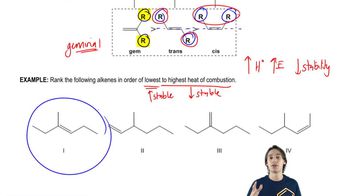
Heat of Combustion

Constitutional Isomers

Constitutional isomers are compounds that have the same molecular formula but differ in the connectivity of their atoms. This difference in structure can lead to variations in physical and chemical properties, including heat of combustion. Recognizing the types of isomers is essential for predicting their behavior during combustion.
추천 영상:
01:10
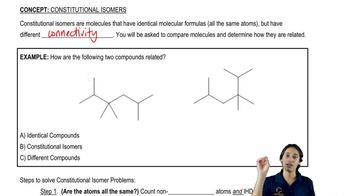
What is a constitutional isomer?

Stability and Energy Content

The stability of a compound is influenced by factors such as the type of bonds present and the arrangement of atoms. Generally, more stable compounds have lower energy content and thus lower heats of combustion. Analyzing the stability of the constitutional isomers of C₆H₁₂ will help determine their ranking based on heat of combustion.
추천 영상:
03:43
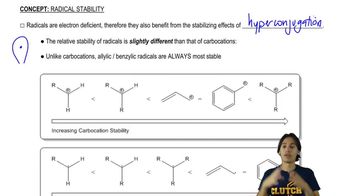
The radical stability trend.