Ch. 5 - Chemical Reaction Analysis: Thermodynamics and Kinetics
Mullins - Organic Chemistry: A Learner Centered Approach 1st Edition
Mullins1st EditionOrganic Chemistry: A Learner Centered ApproachISBN: 9780137566471당신이 사용하는 게 아니라요?교과서 변경
4장, 문제 25b

Calculate ∆G°, ∆H°, and ∆S° for the following acid–base reactions. Rationalize the value of ∆H° based on the structure of the conjugate bases. [Assume T = 298 K.]
(b)

검증된 단계별 안내
1
Step 1: Identify the acid and base in the reaction. The molecule on the left (with the -OH group) acts as the acid, donating a proton to form the conjugate base (on the right, with the -O⁻ group). The molecule on the right (with the -NH₃⁺ group) acts as the conjugate acid formed from the base.
Step 2: Write the expression for ∆G° using the equation ∆G° = ∆H° - T∆S°. Here, T is given as 298 K. To calculate ∆G°, you need the values of ∆H° and ∆S°, which can be determined experimentally or provided in the problem.
Step 3: Rationalize the value of ∆H° based on the structure of the conjugate bases. The conjugate base formed (with the -O⁻ group) is stabilized by resonance, as the negative charge can delocalize onto the carbonyl oxygen. This stabilization lowers the energy of the conjugate base, contributing to the enthalpy change (∆H°).
Step 4: Consider the entropy change (∆S°). The reaction involves the transfer of a proton, which may increase disorder in the system. Evaluate the molecular changes to determine whether ∆S° is positive or negative.
Step 5: Combine the calculated or provided values of ∆H° and ∆S° into the equation ∆G° = ∆H° - T∆S° to determine the Gibbs free energy change for the reaction. This will indicate whether the reaction is thermodynamically favorable under standard conditions.

비슷한 문제에 대한 검증된 영상 답변:

이 영상 해법은 위 문제에 도움이 된다고 튜터들이 추천한 것입니다.

주요 개념

질문에 올바르게 답하기 위해 반드시 이해해야 하는 핵심 개념들은 다음과 같습니다.

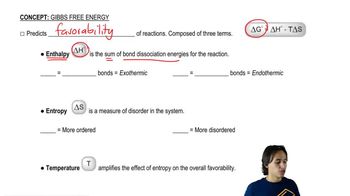
Gibbs Free Energy (∆G°)

Gibbs Free Energy (∆G°) is a thermodynamic potential that measures the maximum reversible work obtainable from a thermodynamic system at constant temperature and pressure. It indicates the spontaneity of a reaction; a negative ∆G° suggests that the reaction can occur spontaneously, while a positive value indicates non-spontaneity. The relationship between ∆G°, enthalpy (∆H°), and entropy (∆S°) is given by the equation ∆G° = ∆H° - T∆S°, where T is the temperature in Kelvin.
추천 영상:
05:02
Breaking down the different terms of the Gibbs Free Energy equation.

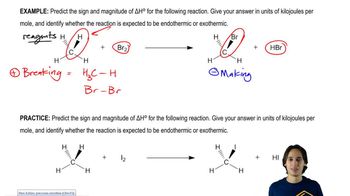
Enthalpy (∆H°)

Enthalpy (∆H°) is a measure of the total heat content of a system and reflects the energy changes during a chemical reaction. It can be either exothermic (releasing heat, ∆H° < 0) or endothermic (absorbing heat, ∆H° > 0). The value of ∆H° can be rationalized by examining the stability and structure of the reactants and products, particularly the strength of bonds formed and broken during the reaction, which influences the overall energy change.
추천 영상:
04:38
Calculating Enthalpies

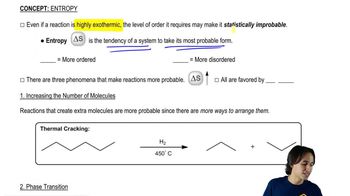
Entropy (∆S°)

Entropy (∆S°) is a measure of the disorder or randomness in a system. In chemical reactions, an increase in entropy (∆S° > 0) typically corresponds to a greater number of microstates or configurations available to the system, often seen in reactions that produce gases from solids or liquids. Understanding the changes in entropy is crucial for predicting the spontaneity of reactions, as it directly influences the Gibbs Free Energy equation.
추천 영상:
02:46
Explaining what entropy is.