Ch. 5 - Chemical Reaction Analysis: Thermodynamics and Kinetics
Mullins - Organic Chemistry: A Learner Centered Approach 1st Edition
Mullins1st EditionOrganic Chemistry: A Learner Centered ApproachISBN: 9780137566471당신이 사용하는 게 아니라요?교과서 변경
4장, 문제 37a

Calculate ∆H° for the following reactions.
(a) Chemical reaction equation showing reactants and products with methane and hydrogen.

검증된 단계별 안내
1
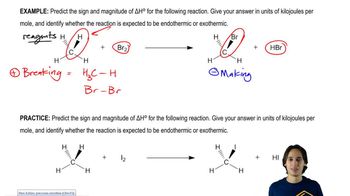
Step 1: Identify the bonds broken and formed in the reaction. In the given reaction, bonds in the reactants are broken, and new bonds are formed in the products. Specifically, a C-H bond in CH4 is broken, and a C-H bond in the alkane is formed.
Step 2: Use bond dissociation energy (BDE) values to calculate the energy change for breaking and forming bonds. Bond dissociation energy is the energy required to break a bond. Look up the BDE values for the C-H bond in CH4 and the C-H bond in the alkane.
Step 3: Calculate the total energy required to break the bonds in the reactants. Sum the BDE values for all bonds broken in the reaction.
Step 4: Calculate the total energy released when new bonds are formed in the products. Sum the BDE values for all bonds formed in the reaction.
Step 5: Determine ∆H° for the reaction by subtracting the total energy released (from Step 4) from the total energy required (from Step 3). Use the formula: ∆H° = Σ(Bonds Broken) - Σ(Bonds Formed).

비슷한 문제에 대한 검증된 영상 답변:

이 영상 해법은 위 문제에 도움이 된다고 튜터들이 추천한 것입니다.

주요 개념

질문에 올바르게 답하기 위해 반드시 이해해야 하는 핵심 개념들은 다음과 같습니다.

Enthalpy Change (∆H°)

Enthalpy change (∆H°) is a measure of the heat content of a system at constant pressure. It indicates whether a reaction is exothermic (releases heat, ∆H° < 0) or endothermic (absorbs heat, ∆H° > 0). Calculating ∆H° for a reaction involves determining the difference in enthalpy between products and reactants, often using standard enthalpy values.
추천 영상:
04:38
Calculating Enthalpies

Reaction Mechanism

A reaction mechanism describes the step-by-step sequence of elementary reactions by which overall chemical change occurs. Understanding the mechanism helps in predicting the products and the energy changes involved. In the given reaction, knowing how the alkene interacts with methane to produce another alkene and hydrogen is crucial for calculating ∆H°.
추천 영상:
02:16
Heck Reaction Mechanism

Bond Energies

Bond energies refer to the amount of energy required to break a bond between two atoms. In thermodynamic calculations, the total energy required to break bonds in the reactants minus the energy released when new bonds form in the products gives the overall enthalpy change. This concept is essential for calculating ∆H° in the provided reaction, as it involves breaking and forming specific bonds.
추천 영상:
06:00
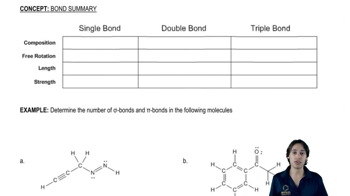
Single bonds, double bonds, and triple bonds.