Ch. 5 - Chemical Reaction Analysis: Thermodynamics and Kinetics
Mullins - Organic Chemistry: A Learner Centered Approach 1st Edition
Mullins1st EditionOrganic Chemistry: A Learner Centered ApproachISBN: 9780137566471당신이 사용하는 게 아니라요?교과서 변경
4장, 문제 20b

Draw a reaction coordinate diagram for a one step reaction that has the following values of Ea and ∆H. (b) Ea = 2 kcal/mol ; ∆H° = -17 kcal/mol

검증된 단계별 안내
1
Understand the key terms: Eₐ (activation energy) is the energy barrier that must be overcome for the reaction to proceed, and ∆H° (enthalpy change) is the difference in energy between the reactants and products. A negative ∆H° indicates an exothermic reaction, where the products are lower in energy than the reactants.
Start by drawing the x-axis (reaction progress) and y-axis (energy) for the reaction coordinate diagram. Label the axes appropriately.
Plot the energy of the reactants as a starting point on the y-axis. Since the reaction is exothermic (∆H° = -17 kcal/mol), the energy of the products will be lower than that of the reactants by 17 kcal/mol.
Add the activation energy (Eₐ = 2 kcal/mol) as a peak above the reactants' energy level. The height of this peak relative to the reactants' energy represents the activation energy barrier.
Draw a smooth curve starting from the reactants' energy level, rising to the peak (activation energy), and then descending to the products' energy level, which is 17 kcal/mol lower than the reactants. Label the peak as the transition state and indicate the values of Eₐ and ∆H° on the diagram.

비슷한 문제에 대한 검증된 영상 답변:

이 영상 해법은 위 문제에 도움이 된다고 튜터들이 추천한 것입니다.

주요 개념

질문에 올바르게 답하기 위해 반드시 이해해야 하는 핵심 개념들은 다음과 같습니다.

Reaction Coordinate Diagram

A reaction coordinate diagram is a graphical representation that illustrates the energy changes during a chemical reaction. The x-axis typically represents the progress of the reaction, while the y-axis shows the energy of the system. It highlights the transition state, the energy of reactants and products, and the activation energy (Eₐ), providing insight into the reaction mechanism and thermodynamics.
추천 영상:
05:02
Coordination Complexes

Activation Energy (Eₐ)

Activation energy (Eₐ) is the minimum energy required for a reaction to occur. It represents the energy barrier that must be overcome for reactants to transform into products. In the context of the given values, a low Eₐ of 2 kcal/mol indicates that the reaction can proceed relatively easily, suggesting a fast reaction rate under appropriate conditions.
추천 영상:
08:30
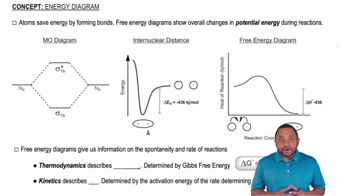
Introduction to free energy diagrams.

Enthalpy Change (∆H°)

Enthalpy change (∆H°) refers to the difference in energy between the reactants and products of a reaction. A negative ∆H° value, such as -17 kcal/mol, indicates that the reaction is exothermic, meaning it releases energy to the surroundings. This information is crucial for understanding the thermodynamic favorability of the reaction and its potential to occur spontaneously.
추천 영상:
04:38
Calculating Enthalpies