Ch. 5 - Chemical Reaction Analysis: Thermodynamics and Kinetics
Mullins - Organic Chemistry: A Learner Centered Approach 1st Edition
Mullins1st EditionOrganic Chemistry: A Learner Centered ApproachISBN: 9780137566471당신이 사용하는 게 아니라요?교과서 변경
4장, 문제 48a(iv)

For each of the following acid–base reactions, (iv) draw the transition state, paying close attention to the degree of bond forming and breaking present in the transition state. If a pKa is not one of the ten common ones we learned in Chapter 4, it will be given to you.
(a) Chemical reaction diagram showing hydroxide ion reacting with sulfuric acid to form hydronium and bisulfate ions.

검증된 단계별 안내
1
Identify the acid and base in the given reaction. Recall that the acid donates a proton (H⁺), and the base accepts it. Use the pKₐ values provided or known to determine the relative strengths of the acid and base.
Determine the direction of the reaction based on the pKₐ values. The reaction will favor the side with the weaker acid (higher pKₐ) and weaker base.
Draw the transition state for the reaction. In the transition state, partial bonds are formed and broken. Represent this using dashed lines to indicate the degree of bond formation and cleavage.
Pay attention to the geometry of the molecules in the transition state. For example, if a proton is being transferred, show the proton midway between the donor and acceptor atoms, with partial charges (δ⁺ and δ⁻) on the relevant atoms.
Label the transition state with the double dagger symbol (‡) and ensure that all partial charges and bond changes are clearly indicated. This will help visualize the energy barrier the reaction must overcome.

비슷한 문제에 대한 검증된 영상 답변:

이 영상 해법은 위 문제에 도움이 된다고 튜터들이 추천한 것입니다.

주요 개념

질문에 올바르게 답하기 위해 반드시 이해해야 하는 핵심 개념들은 다음과 같습니다.

Acid-Base Reactions

Acid-base reactions involve the transfer of protons (H⁺) between reactants. An acid is defined as a proton donor, while a base is a proton acceptor. Understanding the nature of these reactions is crucial for predicting the products and the stability of intermediates, including transition states.
추천 영상:
02:49
The Lewis definition of acids and bases.

Transition State Theory

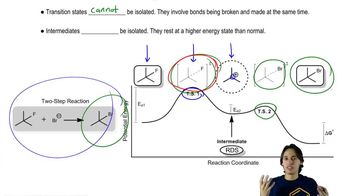
Transition state theory describes the high-energy state that occurs during a chemical reaction, where bonds are partially broken and formed. The transition state represents the point of maximum energy along the reaction pathway, and its structure is critical for understanding reaction mechanisms and kinetics.
추천 영상:
06:55
Intermediates vs. Transition States

pKₐ and Acid Strength

The pKₐ value is a quantitative measure of an acid's strength, indicating its tendency to donate protons. A lower pKₐ value corresponds to a stronger acid, while a higher pKₐ indicates a weaker acid. Knowledge of pKₐ values is essential for predicting the direction of acid-base reactions and the stability of transition states.
추천 영상:
03:09
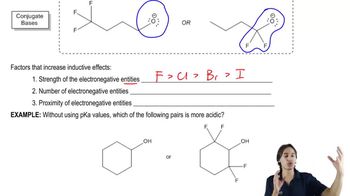
The 3 factors that determine the strength of inductive effects.