Ch. 5 - Chemical Reaction Analysis: Thermodynamics and Kinetics
Mullins - Organic Chemistry: A Learner Centered Approach 1st Edition
Mullins1st EditionOrganic Chemistry: A Learner Centered ApproachISBN: 9780137566471당신이 사용하는 게 아니라요?교과서 변경
4장, 문제 63d

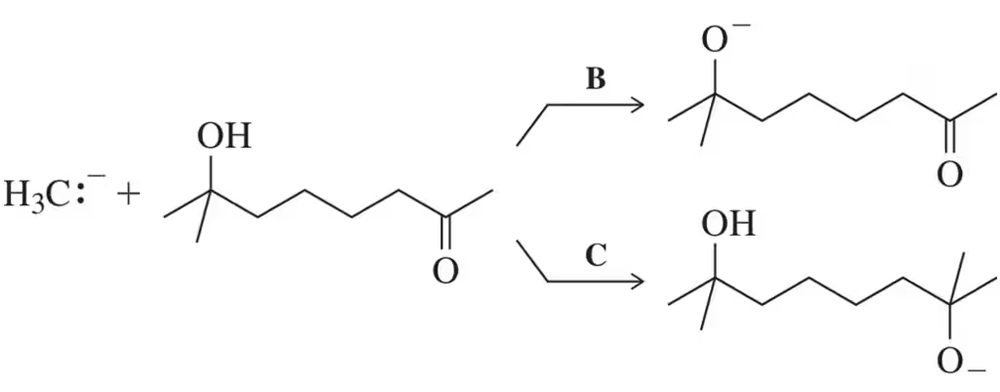
In light of your answers to parts (b) and (c), where both were shown to be quite favorable, imagine a scenario where either reaction is possible. Of the two, which would you expect to be faster? Which would you expect to be more favored? Explain each in the context of the important thermodynamic and/or kinetic parameters.
Chemical reaction diagram showing reactants and products with arrows indicating possible reaction pathways.

검증된 단계별 안내
1
Step 1: Begin by reviewing the concepts of thermodynamics and kinetics in organic reactions. Thermodynamics refers to the favorability of a reaction based on energy changes (e.g., enthalpy and entropy), while kinetics refers to the speed of the reaction, which depends on the activation energy (Ea).
Step 2: Recall the answers to parts (b) and (c) of the problem. Identify which reaction was shown to be more thermodynamically favorable (lower Gibbs free energy, ΔG) and which had a lower activation energy (Ea), as these will guide your analysis.
Step 3: Analyze the reaction that is expected to be faster. A faster reaction is typically associated with a lower activation energy (Ea), as this means the energy barrier for the reaction to proceed is smaller. Compare the Ea values of the two reactions to determine which is kinetically favored.
Step 4: Analyze the reaction that is expected to be more favored overall. A more favored reaction is typically associated with a more negative ΔG, indicating that the products are more stable than the reactants. Compare the thermodynamic favorability of the two reactions based on their ΔG values.
Step 5: Synthesize your findings. Conclude which reaction is faster (kinetically favored) and which is more thermodynamically favored. Provide a clear explanation of how the kinetic and thermodynamic parameters influence each reaction, and discuss any potential trade-offs between speed and favorability in the context of the given scenario.

비슷한 문제에 대한 검증된 영상 답변:

이 영상 해법은 위 문제에 도움이 된다고 튜터들이 추천한 것입니다.
영상 길이:
11m

주요 개념

질문에 올바르게 답하기 위해 반드시 이해해야 하는 핵심 개념들은 다음과 같습니다.

Thermodynamics

Thermodynamics in organic chemistry refers to the study of energy changes during chemical reactions. It helps determine the favorability of a reaction based on Gibbs free energy, where a negative change indicates a spontaneous process. Understanding thermodynamic stability allows chemists to predict which products are favored at equilibrium, influencing reaction pathways and outcomes.
추천 영상:
08:51
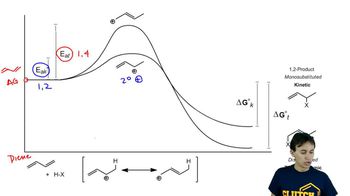
Kinetic vs. Thermodynamic Control

Kinetics

Kinetics is the branch of chemistry that deals with the rates of chemical reactions. It examines how factors such as concentration, temperature, and catalysts affect the speed of a reaction. By analyzing the activation energy and reaction mechanisms, chemists can determine which reaction will proceed faster, even if it is not the most thermodynamically favorable.
추천 영상:
08:51
Kinetic vs. Thermodynamic Control

Reaction Mechanisms

A reaction mechanism is a step-by-step description of the pathway taken during a chemical reaction. It outlines the sequence of elementary steps, intermediates, and transition states involved. Understanding the mechanism is crucial for predicting both the rate and the favorability of reactions, as it provides insight into the molecular interactions and energy barriers that influence the overall process.
추천 영상:
02:16
Heck Reaction Mechanism