
Ch. 5 - Chemical Reaction Analysis: Thermodynamics and Kinetics
Mullins - Organic Chemistry: A Learner Centered Approach 1st Edition
Mullins1st EditionOrganic Chemistry: A Learner Centered ApproachISBN: 9780137566471당신이 사용하는 게 아니라요?교과서 변경
4장, 문제 72a

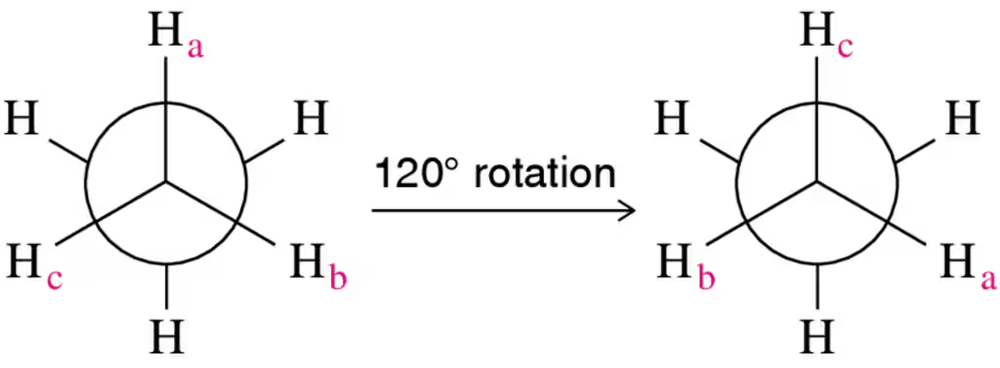
Parts (a)–(f) of this assessment refer to the rotation around the single bond of ethane.

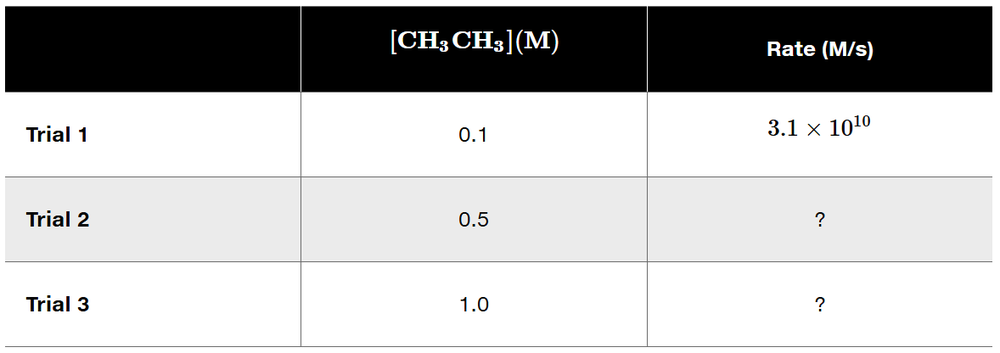
(a) Given that the rate of the reaction is independent of concentration, fill in the missing rates in the following table.
Table showing trials with concentration of ethane and corresponding reaction rates, with some rates missing.

검증된 단계별 안내
1
Step 1: Understand the concept of rotation around a single bond in ethane. Ethane (C₂H₆) has a single bond between the two carbon atoms, and the rotation around this bond leads to different conformations (e.g., staggered and eclipsed). The energy barrier for this rotation is due to torsional strain.
Step 2: Recognize that the rate of reaction being independent of concentration indicates a zero-order reaction. In zero-order reactions, the rate is constant and does not depend on the concentration of reactants.
Step 3: Analyze the given table and identify the missing rates. Since the rate is constant in a zero-order reaction, all rates in the table should be the same regardless of the concentration values.
Step 4: Use the concept of zero-order kinetics to fill in the missing rates. The rate can be expressed mathematically as: Rate = k, where k is the rate constant.
Step 5: Ensure consistency in the table by verifying that all rates match the constant rate value provided or calculated based on the zero-order reaction principle.

비슷한 문제에 대한 검증된 영상 답변:

이 영상 해법은 위 문제에 도움이 된다고 튜터들이 추천한 것입니다.
영상 길이:
2m

주요 개념

질문에 올바르게 답하기 위해 반드시 이해해야 하는 핵심 개념들은 다음과 같습니다.

Ethane Structure and Conformation

Ethane (C2H6) consists of two carbon atoms connected by a single bond, allowing for rotation around this bond. This rotation leads to different conformations, such as staggered and eclipsed forms, which influence the molecule's stability and energy. Understanding these conformations is essential for analyzing reaction rates and mechanisms involving ethane.
추천 영상:
03:29
Understanding what a conformer is.

Reaction Rate and Concentration Independence

In chemical kinetics, the reaction rate is often dependent on the concentration of reactants. However, if a reaction's rate is independent of concentration, it suggests that the reaction may be zero-order with respect to the reactants involved. This concept is crucial for filling in missing rates in the provided table, as it indicates that changes in concentration do not affect the rate of the reaction.
추천 영상:
가이드 코스
5:07
Rates of Intramolecular Reactions Concept 2

Kinetic Theory and Activation Energy

Kinetic theory explains how the energy of molecules affects reaction rates. Activation energy is the minimum energy required for a reaction to occur. In the context of ethane's rotation, understanding how energy barriers influence the rate of conformational changes is vital, especially when considering that the reaction rate remains constant despite concentration changes.
추천 영상:
08:30
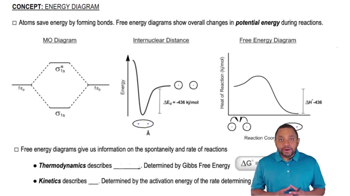
Introduction to free energy diagrams.