
Ch. 5 - Chemical Reaction Analysis: Thermodynamics and Kinetics
Mullins - Organic Chemistry: A Learner Centered Approach 1st Edition
Mullins1st EditionOrganic Chemistry: A Learner Centered ApproachISBN: 9780137566471당신이 사용하는 게 아니라요?교과서 변경
4장, 문제 45a

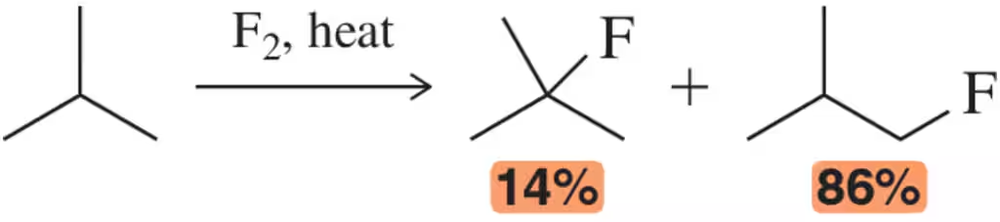
The radical fluorination of 2-methyl propane resulted in a 14:86 ratio of products.
Diagram showing the radical fluorination of 2-methyl propane, with product ratios of 14% and 86%.
(a) On the basis of this ratio, calculate the relative reactivity of 1° and 3° C―H bonds in the radical fluorination.

검증된 단계별 안내
1
Identify the types of C―H bonds in 2-methylpropane. The molecule has primary (1°) hydrogens attached to the methyl groups and tertiary (3°) hydrogens attached to the central carbon.
Determine the number of each type of C―H bond. In 2-methylpropane, there are 9 primary hydrogens (3 hydrogens on each of the three methyl groups) and 1 tertiary hydrogen (on the central carbon).
Use the given product ratio (14:86) to determine the relative likelihood of abstraction of each type of hydrogen. The ratio corresponds to the number of products formed from primary and tertiary hydrogens, respectively.
Set up the relative reactivity equation. The relative reactivity of 1° to 3° C―H bonds can be calculated using the formula: \( \text{Relative Reactivity} = \frac{\text{Product Ratio}}{\text{Number of Hydrogens}} \). For primary hydrogens: \( \text{Reactivity of 1°} = \frac{14}{9} \), and for tertiary hydrogens: \( \text{Reactivity of 3°} = \frac{86}{1} \).
Calculate the relative reactivity of 1° to 3° C―H bonds by dividing the reactivity of 3° hydrogens by the reactivity of 1° hydrogens. This will give the relative reactivity ratio.

비슷한 문제에 대한 검증된 영상 답변:

이 영상 해법은 위 문제에 도움이 된다고 튜터들이 추천한 것입니다.
영상 길이:
4m

주요 개념

질문에 올바르게 답하기 위해 반드시 이해해야 하는 핵심 개념들은 다음과 같습니다.

Radical Reactivity

Radical reactivity refers to the tendency of different types of carbon-hydrogen (C-H) bonds to undergo homolytic cleavage and form radicals. In the context of fluorination, primary (1°) and tertiary (3°) C-H bonds exhibit different reactivities due to the stability of the resulting radicals. Tertiary radicals are generally more stable than primary radicals, leading to a higher likelihood of fluorination occurring at 3° C-H bonds compared to 1° C-H bonds.
추천 영상:
가이드 코스
1:30
Radical Polymerization Concept 4

Product Ratio Interpretation

The product ratio obtained from the radical fluorination (14:86) indicates the relative amounts of products formed from 1° and 3° C-H bond reactions. This ratio can be used to infer the relative reactivity of the C-H bonds involved. By analyzing the ratio, one can deduce how many times more reactive one type of bond is compared to another, which is essential for calculating the relative reactivity of 1° and 3° C-H bonds in this reaction.
추천 영상:
11:07
Bridged-Products

Calculating Relative Reactivity

To calculate the relative reactivity of 1° and 3° C-H bonds, one can use the product ratio derived from the radical fluorination. The formula involves comparing the number of products formed from each type of bond. By setting up a ratio based on the product distribution, one can derive a numerical value that quantifies how much more reactive one type of C-H bond is compared to the other, providing insight into the mechanism of the reaction.
추천 영상:
04:32
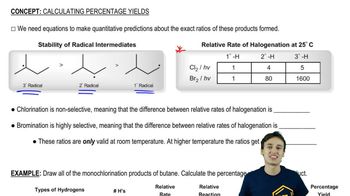
Explaining relative rates of halogenation.