Ch. 6 - Stereoisomerism: Arrangement of Atoms in Space
Mullins - Organic Chemistry: A Learner Centered Approach 1st Edition
Mullins1st EditionOrganic Chemistry: A Learner Centered ApproachISBN: 9780137566471당신이 사용하는 게 아니라요?교과서 변경
5장, 문제 46h

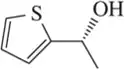
Classify the following objects and molecules as chiral or achiral.
(h) Chemical structure of a molecule featuring a sulfur atom and a hydroxyl group, used for chirality classification.

검증된 단계별 안내
1
Step 1: Understand the concept of chirality. A molecule or object is chiral if it cannot be superimposed on its mirror image. This typically occurs when a carbon atom is bonded to four different groups, creating a stereocenter. If the molecule has a plane of symmetry or can be superimposed on its mirror image, it is achiral.
Step 2: Examine the given object or molecule (h). Identify if there is a carbon atom (or other central atom) that is bonded to four distinct groups. If such a stereocenter exists, the molecule is likely chiral.
Step 3: Check for symmetry. Look for planes of symmetry or centers of symmetry in the molecule. If the molecule has a plane of symmetry, it is achiral, even if it has stereocenters.
Step 4: Consider the 3D structure of the molecule. Visualize or draw the molecule in three dimensions to determine if it can be superimposed on its mirror image. If it cannot, it is chiral; otherwise, it is achiral.
Step 5: Conclude the classification based on your analysis. If the molecule has no stereocenters or has symmetry, classify it as achiral. If it has stereocenters and lacks symmetry, classify it as chiral.

비슷한 문제에 대한 검증된 영상 답변:

이 영상 해법은 위 문제에 도움이 된다고 튜터들이 추천한 것입니다.
영상 길이:
3m

주요 개념

질문에 올바르게 답하기 위해 반드시 이해해야 하는 핵심 개념들은 다음과 같습니다.

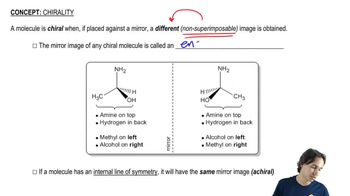
Chirality

Chirality refers to the geometric property of a molecule that makes it non-superimposable on its mirror image. A chiral molecule typically has at least one carbon atom bonded to four different substituents, resulting in two distinct enantiomers. These enantiomers can exhibit different optical activities, which is crucial in fields like pharmaceuticals.
추천 영상:
05:10
What is chirality?

Achirality

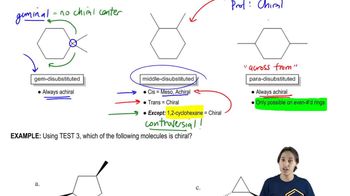
Achirality describes molecules that are superimposable on their mirror images, meaning they do not have a chiral center. Common examples include molecules with a plane of symmetry or those that are symmetrical in structure. Understanding achirality is essential for distinguishing between chiral and achiral substances in organic chemistry.
추천 영상:
04:48
Cis-1,2-Disubstituted Cyclohexane:A controversial exception.

Stereoisomerism

Stereoisomerism is a form of isomerism where molecules have the same molecular formula and connectivity but differ in the spatial arrangement of atoms. This includes both enantiomers (chiral) and diastereomers (not mirror images). Recognizing stereoisomers is vital for classifying molecules as chiral or achiral and understanding their chemical behavior.
추천 영상:
01:58
Determining when molecules are stereoisomers.