Ch. 6 - Stereoisomerism: Arrangement of Atoms in Space
Mullins - Organic Chemistry: A Learner Centered Approach 1st Edition
Mullins1st EditionOrganic Chemistry: A Learner Centered ApproachISBN: 9780137566471당신이 사용하는 게 아니라요?교과서 변경
5장, 문제 41c

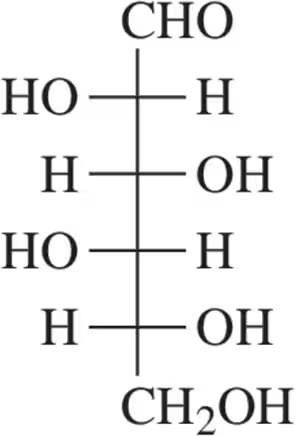
Convert the Fischer projections into line-angle drawings and assign (R) and (S) at each chiral center.
(c) Fischer projection of a chiral molecule with hydroxyl and hydrogen groups, illustrating chiral centers for R and S designation.

검증된 단계별 안내
1
Step 1: Understand the Fischer projection. A Fischer projection is a 2D representation of a molecule where horizontal lines represent bonds projecting out of the plane (toward the viewer) and vertical lines represent bonds projecting behind the plane (away from the viewer). Each intersection represents a chiral center.
Step 2: Convert the Fischer projection into a line-angle drawing. To do this, visualize the molecule in 3D space. Start by identifying the backbone of the molecule (the carbon chain) and arrange the substituents (e.g., OH, H, CHO, CH2OH) in their correct spatial orientations based on the Fischer projection.
Step 3: Assign priorities to the substituents at each chiral center using the Cahn-Ingold-Prelog (CIP) rules. The rules are: (1) Higher atomic number gets higher priority, (2) If two substituents have the same atomic number, consider the atoms directly bonded to them, (3) Double and triple bonds are treated as if the atoms are duplicated or triplicated.
Step 4: Determine the configuration (R or S) at each chiral center. To do this, orient the molecule so that the lowest priority group is pointing away from you. Then, trace a path from the highest priority group to the second and third priority groups. If the path is clockwise, the configuration is (R); if counterclockwise, it is (S).
Step 5: Repeat the process for each chiral center in the molecule. Ensure that you carefully analyze the spatial arrangement of substituents for each center to assign the correct (R) or (S) configuration.

비슷한 문제에 대한 검증된 영상 답변:

이 영상 해법은 위 문제에 도움이 된다고 튜터들이 추천한 것입니다.
영상 길이:
11m

주요 개념

질문에 올바르게 답하기 위해 반드시 이해해야 하는 핵심 개념들은 다음과 같습니다.

Fischer Projections

Fischer projections are a two-dimensional representation of three-dimensional organic molecules, particularly useful for depicting carbohydrates and amino acids. In these projections, vertical lines represent bonds that extend away from the viewer, while horizontal lines indicate bonds that come towards the viewer. Understanding how to interpret Fischer projections is essential for converting them into other representations, such as line-angle drawings.
추천 영상:
09:56
Monosaccharides - Drawing Fischer Projections

Line-Angle Drawings

Line-angle drawings, also known as skeletal structures, are a simplified way of representing organic molecules where vertices represent carbon atoms and lines represent bonds. This format omits hydrogen atoms attached to carbons for clarity, making it easier to visualize complex structures. Mastery of converting Fischer projections to line-angle drawings is crucial for accurately depicting molecular geometry.
추천 영상:
02:46
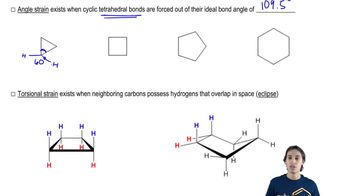
What is angle strain?

Cahn-Ingold-Prelog Priority Rules

The Cahn-Ingold-Prelog (CIP) priority rules are a set of guidelines used to assign the (R) or (S) configuration to chiral centers in organic molecules. These rules prioritize substituents based on atomic number and connectivity, allowing chemists to determine the spatial arrangement of groups around a chiral center. Correctly applying these rules is vital for accurately designating the stereochemistry of a molecule.
추천 영상:
01:48
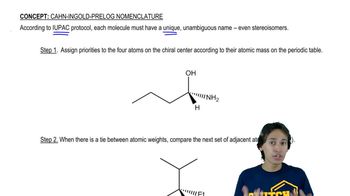
Why stereoisomers need their own naming system.