Ch. 6 - Stereoisomerism: Arrangement of Atoms in Space
Mullins - Organic Chemistry: A Learner Centered Approach 1st Edition
Mullins1st EditionOrganic Chemistry: A Learner Centered ApproachISBN: 9780137566471당신이 사용하는 게 아니라요?교과서 변경
5장, 문제 14b

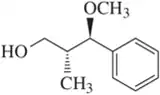
For each of the following chiral molecules, obtain the enantiomer (i) by drawing the nonsuperimposable mirror image and (ii) by switching the spatial orientation at each asymmetric center. Confirm (possibly using models) that the structures you drew for (i) and (ii) are the same.
(b) Chemical structure of a chiral molecule with hydroxyl, methyl, and methoxy groups attached to a carbon chain.

검증된 단계별 안내
1
Identify the chiral center(s) in the given molecule. A chiral center is typically a carbon atom bonded to four different groups. Ensure you clearly mark these centers for reference.
To obtain the enantiomer by drawing the nonsuperimposable mirror image (step i), imagine a mirror placed next to the molecule. Reflect each group attached to the chiral center(s) across the mirror. The positions of the groups should be reversed as if viewed in a mirror.
To obtain the enantiomer by switching the spatial orientation at each asymmetric center (step ii), invert the configuration of each chiral center. This means swapping the positions of any two groups attached to the chiral center. For example, if the groups are arranged in a clockwise (R) configuration, switch them to create a counterclockwise (S) configuration, or vice versa.
Compare the structures obtained in steps (i) and (ii). Use molecular models or visualization tools if necessary to confirm that the two structures are identical. This confirms that both methods yield the same enantiomer.
Verify that the enantiomer is nonsuperimposable on the original molecule. This ensures that the molecule and its enantiomer are true stereoisomers and not identical.

비슷한 문제에 대한 검증된 영상 답변:

이 영상 해법은 위 문제에 도움이 된다고 튜터들이 추천한 것입니다.
영상 길이:
2m

주요 개념

질문에 올바르게 답하기 위해 반드시 이해해야 하는 핵심 개념들은 다음과 같습니다.

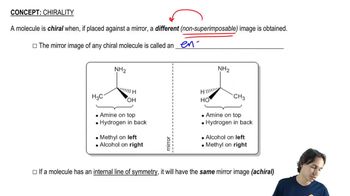
Chirality

Chirality refers to the geometric property of a molecule that makes it non-superimposable on its mirror image. Molecules that possess chirality typically have one or more asymmetric carbon atoms, leading to two distinct forms known as enantiomers. These enantiomers exhibit different optical activities and can have different biological activities, making chirality a crucial concept in organic chemistry.
추천 영상:
05:10
What is chirality?

Enantiomers

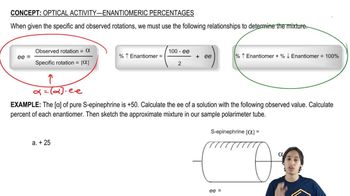
Enantiomers are a pair of chiral molecules that are mirror images of each other. They have identical physical properties, such as melting and boiling points, but differ in how they interact with polarized light and with other chiral substances. Understanding enantiomers is essential for predicting the behavior of chiral compounds in chemical reactions and biological systems.
추천 영상:
03:23
How to solve for the percentage of each enantiomer.

Stereochemistry

Stereochemistry is the study of the spatial arrangement of atoms in molecules and how this arrangement affects their chemical behavior. It encompasses concepts such as chirality, enantiomers, and diastereomers. In the context of the question, switching the spatial orientation at each asymmetric center is a stereochemical operation that helps in identifying the enantiomer of a given chiral molecule.
추천 영상:
가이드 코스
1:38
Polymer Stereochemistry Concept 1