Ch. 6 - Stereoisomerism: Arrangement of Atoms in Space
Mullins - Organic Chemistry: A Learner Centered Approach 1st Edition
Mullins1st EditionOrganic Chemistry: A Learner Centered ApproachISBN: 9780137566471당신이 사용하는 게 아니라요?교과서 변경
5장, 문제 10a

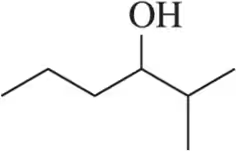
For each of the following molecules, draw one 3-D representation at only the necessary atoms (that is, the ones with four different atoms/groups attached).
(a) 3-D representation of a molecule with an OH group, highlighting necessary atoms with four different attachments.

검증된 단계별 안내
1
Identify the chiral centers in the molecule. A chiral center is a carbon atom that is attached to four different atoms or groups. Look for tetrahedral carbons with four distinct substituents.
Once the chiral centers are identified, assign priorities to the four groups attached to each chiral center based on the Cahn-Ingold-Prelog (CIP) priority rules. These rules prioritize groups based on atomic number, with higher atomic numbers receiving higher priority.
Orient the molecule so that the group with the lowest priority (priority 4) is pointing away from you (into the plane of the paper or screen). This is typically represented with a dashed wedge.
Determine the configuration of the chiral center by tracing a path from priority 1 to priority 2 to priority 3. If the path is clockwise, the configuration is R (rectus). If the path is counterclockwise, the configuration is S (sinister).
Draw the 3-D representation of the molecule, using solid wedges to represent bonds coming out of the plane (toward the viewer) and dashed wedges for bonds going into the plane (away from the viewer). Ensure that the stereochemistry (R or S) is correctly represented for each chiral center.

비슷한 문제에 대한 검증된 영상 답변:

이 영상 해법은 위 문제에 도움이 된다고 튜터들이 추천한 것입니다.
영상 길이:
1m

주요 개념

질문에 올바르게 답하기 위해 반드시 이해해야 하는 핵심 개념들은 다음과 같습니다.

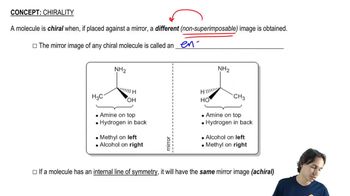
Chirality

Chirality refers to the geometric property of a molecule that makes it non-superimposable on its mirror image, much like left and right hands. A chiral center, typically a carbon atom, is bonded to four different substituents, leading to two distinct enantiomers. Understanding chirality is crucial for predicting the behavior of molecules in biological systems, as enantiomers can have different effects.
추천 영상:
05:10
What is chirality?

3-D Molecular Representation

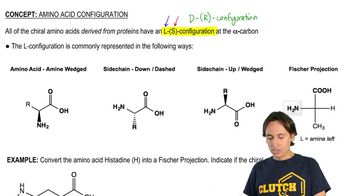
3-D molecular representation involves depicting the spatial arrangement of atoms within a molecule, which is essential for understanding its reactivity and interactions. Techniques such as ball-and-stick models or wedge-dash notation are used to illustrate the three-dimensional structure, highlighting bond angles and the orientation of substituents around chiral centers.
추천 영상:
05:09
Representations of L-Configuration

Stereochemistry

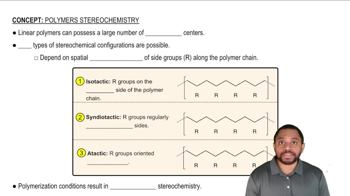
Stereochemistry is the study of the spatial arrangement of atoms in molecules and how this arrangement affects their chemical properties and reactions. It encompasses concepts like chirality, geometric isomerism, and conformational isomerism. A solid grasp of stereochemistry is vital for accurately drawing and interpreting 3-D representations of molecules, especially those with chiral centers.
추천 영상:
가이드 코스
1:38
Polymer Stereochemistry Concept 1