Ch. 6 - Stereoisomerism: Arrangement of Atoms in Space
Mullins - Organic Chemistry: A Learner Centered Approach 1st Edition
Mullins1st EditionOrganic Chemistry: A Learner Centered ApproachISBN: 9780137566471당신이 사용하는 게 아니라요?교과서 변경
5장, 문제 35c

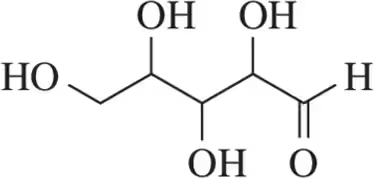
For the molecules shown,
(i) count the number of stereocenters present and
(ii) draw all possible stereoisomers.
(iii) Identify the relationships between stereoisomers as enantiomers or diastereomers.
(c) Chemical structure of a molecule with multiple hydroxyl groups, illustrating stereocenters and potential stereoisomers.

검증된 단계별 안내
1
Step 1: Identify stereocenters in the molecule. A stereocenter is a carbon atom bonded to four different groups. Analyze each carbon atom in the structure to determine if it meets this criterion. In this molecule, focus on the carbons bonded to hydroxyl (-OH) groups and other substituents.
Step 2: Count the number of stereocenters. After identifying the stereocenters, count them to determine how many are present in the molecule. Each stereocenter contributes to the possibility of stereoisomers.
Step 3: Determine the number of possible stereoisomers. Use the formula 2^n, where n is the number of stereocenters, to calculate the total number of possible stereoisomers for the molecule.
Step 4: Draw all possible stereoisomers. For each stereocenter, consider the two possible configurations (R and S). Combine these configurations systematically to generate all stereoisomers. Represent each stereoisomer with its correct 3D structure, showing the spatial arrangement of groups around each stereocenter.
Step 5: Identify relationships between stereoisomers. Compare the stereoisomers to determine if they are enantiomers (non-superimposable mirror images) or diastereomers (stereoisomers that are not mirror images). Use the configurations (R/S) of the stereocenters to establish these relationships.

비슷한 문제에 대한 검증된 영상 답변:

이 영상 해법은 위 문제에 도움이 된다고 튜터들이 추천한 것입니다.
영상 길이:
6m

주요 개념

질문에 올바르게 답하기 위해 반드시 이해해야 하는 핵심 개념들은 다음과 같습니다.

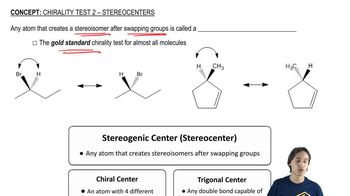
Stereocenters

Stereocenters, or chiral centers, are atoms in a molecule that have four different substituents attached to them, leading to non-superimposable mirror images known as enantiomers. Identifying stereocenters is crucial for understanding the three-dimensional arrangement of atoms in a molecule, which directly influences its chemical properties and biological activity.
추천 영상:
02:15
What is a stereocenter?

Stereoisomers

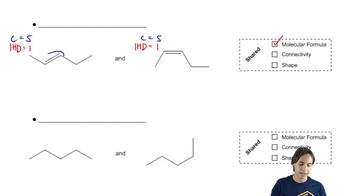
Stereoisomers are compounds that have the same molecular formula and connectivity of atoms but differ in the spatial arrangement of their atoms. This category includes enantiomers, which are mirror images of each other, and diastereomers, which are not mirror images. Understanding stereoisomers is essential for predicting the behavior of molecules in chemical reactions and biological systems.
추천 영상:
01:58
Determining when molecules are stereoisomers.

Enantiomers and Diastereomers

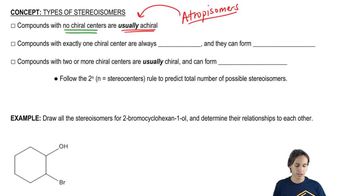
Enantiomers are a type of stereoisomer that are non-superimposable mirror images of each other, often exhibiting different optical activities. Diastereomers, on the other hand, are stereoisomers that are not mirror images and typically have different physical properties. Recognizing the relationships between stereoisomers as enantiomers or diastereomers is vital for understanding their reactivity and interactions in various chemical contexts.
추천 영상:
03:44
Using chiral centers to predict types of stereoisomers.