Ch. 8 - Alkenes 1: Properties and Electrophilic Additions
Mullins - Organic Chemistry: A Learner Centered Approach 1st Edition
Mullins1st EditionOrganic Chemistry: A Learner Centered ApproachISBN: 9780137566471당신이 사용하는 게 아니라요?교과서 변경
7장, 문제 65

Cyclooctene is one of the smaller rings that can form a trans alkene. Would you expect cis-cyclooctene or trans-cyclooctene to react more quickly in an acid-catalyzed hydration reaction?

검증된 단계별 안내
1
Step 1: Understand the reaction mechanism for acid-catalyzed hydration. This reaction involves the addition of water across the double bond of an alkene in the presence of an acid catalyst, forming an alcohol. The reaction proceeds via the formation of a carbocation intermediate.
Step 2: Analyze the structures of cis-cyclooctene and trans-cyclooctene. Cis-cyclooctene has a double bond in a configuration where both substituents are on the same side of the ring, while trans-cyclooctene has substituents on opposite sides of the ring. The trans configuration introduces significant ring strain due to the geometry of the eight-membered ring.
Step 3: Consider the stability of the carbocation intermediate formed during the reaction. The cis configuration allows for a more planar transition state, reducing steric hindrance and strain, which facilitates the formation of the carbocation. In contrast, the trans configuration has higher strain and steric hindrance, making carbocation formation less favorable.
Step 4: Evaluate the reactivity of the two isomers. Cis-cyclooctene is expected to react more quickly in the acid-catalyzed hydration reaction because its geometry is less strained and allows for easier access to the double bond by the acid catalyst.
Step 5: Conclude that the cis isomer is more reactive in this reaction due to reduced ring strain and steric hindrance, which favor the formation of the carbocation intermediate and subsequent hydration.

비슷한 문제에 대한 검증된 영상 답변:

이 영상 해법은 위 문제에 도움이 된다고 튜터들이 추천한 것입니다.

주요 개념

질문에 올바르게 답하기 위해 반드시 이해해야 하는 핵심 개념들은 다음과 같습니다.

Alkene Reactivity

Alkenes are hydrocarbons that contain a carbon-carbon double bond, which is a site of high reactivity. The reactivity of alkenes in reactions such as acid-catalyzed hydration is influenced by the steric and electronic factors associated with their geometry. Generally, more substituted alkenes are more reactive due to greater stability of the carbocation intermediates formed during the reaction.
추천 영상:
가이드 코스
2:09
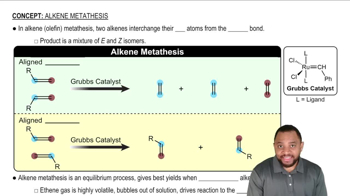
Alkene Metathesis Concept 1

Cis-Trans Isomerism

Cis-trans isomerism, also known as geometric isomerism, occurs in alkenes due to the restricted rotation around the double bond. In cis isomers, substituents are on the same side of the double bond, while in trans isomers, they are on opposite sides. This difference in spatial arrangement can significantly affect the physical and chemical properties of the compounds, including their reactivity in certain reactions.
추천 영상:
00:44
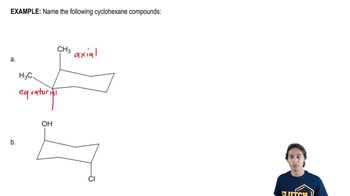
Is the following cyclohexane cis or trans?

Acid-Catalyzed Hydration

Acid-catalyzed hydration is a reaction where water is added to an alkene in the presence of an acid catalyst, leading to the formation of an alcohol. The mechanism typically involves the protonation of the alkene to form a more stable carbocation, followed by nucleophilic attack by water. The stability of the carbocation intermediate is crucial, as more stable intermediates lead to faster reaction rates, which can be influenced by the alkene's geometry.
추천 영상:
06:34
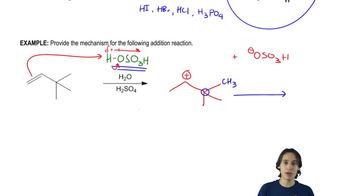
Acid-catalyzed hydration mechanism