

Ch. 8 - Alkenes 1: Properties and Electrophilic Additions
Mullins - Organic Chemistry: A Learner Centered Approach 1st Edition
Mullins1st EditionOrganic Chemistry: A Learner Centered ApproachISBN: 9780137566471당신이 사용하는 게 아니라요?교과서 변경
7장, 문제 1b(i)

(i) Using bond dissociation energies, calculate ∆H° for the following reactions. [BDE for O―H = 110 kcal /mol.]
(b)

검증된 단계별 안내
1
Step 1: Understand the concept of bond dissociation energy (BDE). BDE is the energy required to break a bond in a molecule into its individual atoms in the gas phase. It is used to estimate the enthalpy change (∆H°) of a reaction by considering the bonds broken and formed during the reaction.
Step 2: Write down the chemical equation for the reaction. Identify all the bonds that are broken in the reactants and all the bonds that are formed in the products.
Step 3: Use the given bond dissociation energy (BDE) values. For example, the BDE for O―H is provided as 110 kcal/mol. Look up or use additional BDE values for other bonds involved in the reaction if necessary.
Step 4: Calculate the total energy required to break the bonds in the reactants. This is done by summing the BDE values for all the bonds broken.
Step 5: Calculate the total energy released when new bonds are formed in the products. Subtract the energy released (from bond formation) from the energy required (from bond breaking) to determine the overall ∆H° for the reaction.

비슷한 문제에 대한 검증된 영상 답변:

이 영상 해법은 위 문제에 도움이 된다고 튜터들이 추천한 것입니다.
영상 길이:
4m

주요 개념

질문에 올바르게 답하기 위해 반드시 이해해야 하는 핵심 개념들은 다음과 같습니다.

Bond Dissociation Energy (BDE)

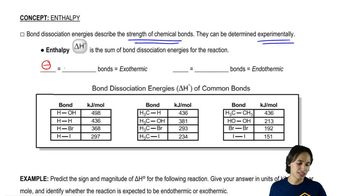
Bond Dissociation Energy is the energy required to break a specific bond in a molecule, resulting in the formation of two radicals. It is a crucial concept in thermochemistry as it helps predict the stability of molecules and the energy changes during chemical reactions. Higher BDE values indicate stronger bonds, which require more energy to break.
추천 영상:
04:09
How to calculate enthalpy using bond dissociation energies.

Enthalpy Change (∆H°)

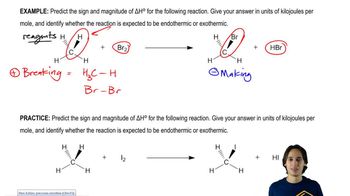
Enthalpy change (∆H°) refers to the heat content change of a system at constant pressure during a chemical reaction. It can be calculated using bond dissociation energies by summing the energies of bonds broken and subtracting the energies of bonds formed. Understanding ∆H° is essential for predicting whether a reaction is exothermic or endothermic.
추천 영상:
04:38
Calculating Enthalpies

Thermochemical Equations

Thermochemical equations represent the relationship between chemical reactions and the heat changes associated with them. They provide a way to quantify the energy changes in reactions, allowing chemists to calculate ∆H° using bond dissociation energies. These equations are vital for understanding reaction mechanisms and energy profiles.
추천 영상:
05:02
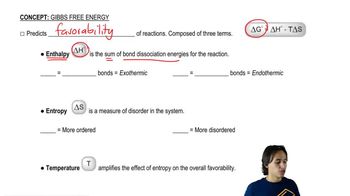
Breaking down the different terms of the Gibbs Free Energy equation.