Ch. 8 - Alkenes 1: Properties and Electrophilic Additions
Mullins - Organic Chemistry: A Learner Centered Approach 1st Edition
Mullins1st EditionOrganic Chemistry: A Learner Centered ApproachISBN: 9780137566471당신이 사용하는 게 아니라요?교과서 변경
7장, 문제 79h

In addition to radicals, anions, and cations, a fourth class of reactive intermediates is carbenes. A neutral species, the simplest carbene has a molecular formula of CH2.
(h) Of the reactions studied here in Chapter 8, cyclopropanation is most similar to which?

검증된 단계별 안내
1
Carbenes are neutral reactive intermediates with a divalent carbon atom that has two nonbonding electrons. The simplest carbene is methylene (CH₂). Carbenes can participate in various reactions, including cyclopropanation.
Cyclopropanation is a reaction where a carbene reacts with an alkene to form a cyclopropane ring. This involves the addition of the carbene across the double bond of the alkene.
To determine which reaction cyclopropanation is most similar to, consider the mechanism. Cyclopropanation involves the addition of a species (the carbene) to a double bond, forming a three-membered ring.
Compare this to other reactions studied in Chapter 8. For example, electrophilic addition reactions involve the addition of an electrophile to a double bond, which is conceptually similar to the addition of a carbene to a double bond in cyclopropanation.
Thus, cyclopropanation is most similar to electrophilic addition reactions, as both involve the addition of a reactive species to a double bond, leading to the formation of a new product.

비슷한 문제에 대한 검증된 영상 답변:

이 영상 해법은 위 문제에 도움이 된다고 튜터들이 추천한 것입니다.

주요 개념

질문에 올바르게 답하기 위해 반드시 이해해야 하는 핵심 개념들은 다음과 같습니다.

Carbenes

Carbenes are neutral reactive intermediates that contain a carbon atom with only six valence electrons, making them highly reactive. The simplest carbene, methylene (CH₂), can participate in various chemical reactions, including addition to double bonds. Understanding carbenes is crucial for predicting their behavior in organic reactions, particularly in cyclopropanation.
추천 영상:
01:48
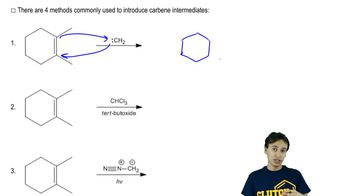
Reaction with a simple carbene.

Cyclopropanation

Cyclopropanation is a chemical reaction that involves the formation of a cyclopropane ring by the addition of a carbene to a double bond. This reaction is significant in organic synthesis as it allows for the creation of three-membered rings, which are valuable intermediates in the synthesis of more complex molecules. Recognizing the mechanism of cyclopropanation helps in comparing it to other reactions.
추천 영상:
01:49
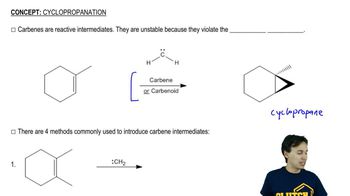
General properties of cyclopropanation.

Reactivity of Intermediates

The reactivity of intermediates like carbenes, radicals, anions, and cations is fundamental in organic chemistry. Each type of intermediate has distinct properties and reactivity patterns that influence the course of chemical reactions. Understanding these differences is essential for predicting the outcomes of reactions, including which reactions are similar to cyclopropanation.
추천 영상:
02:47
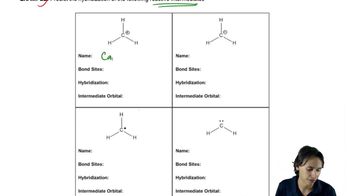
Introduction to the reactive intermediates.