Ch. 8 - Alkenes 1: Properties and Electrophilic Additions
Mullins - Organic Chemistry: A Learner Centered Approach 1st Edition
Mullins1st EditionOrganic Chemistry: A Learner Centered ApproachISBN: 9780137566471당신이 사용하는 게 아니라요?교과서 변경
7장, 문제 7d

What is the index of hydrogen deficiency for each of the following molecular formulas?
(d) C9H12N2O2

검증된 단계별 안내
1
Step 1: Understand the concept of the Index of Hydrogen Deficiency (IHD). The IHD, also known as the degree of unsaturation, indicates the number of rings, double bonds, or triple bonds in a molecule. It is calculated using the formula: IHD = (2C + 2 + N - H - X) / 2, where C = number of carbons, H = number of hydrogens, N = number of nitrogens, and X = number of halogens (if present). Oxygen atoms do not affect the IHD calculation.
Step 2: Identify the values for the molecular formula C₉H₁₂N₂O₂. Here, C = 9, H = 12, N = 2, and there are no halogens (X = 0). Oxygen atoms are present, but they do not contribute to the IHD calculation.
Step 3: Substitute the values into the IHD formula: IHD = (2(9) + 2 + 2 - 12 - 0) / 2. Simplify the expression step by step to determine the numerator.
Step 4: Divide the simplified numerator by 2 to calculate the IHD. This will give you the total number of rings and/or multiple bonds in the molecule.
Step 5: Interpret the result. If the IHD is 0, the molecule is fully saturated (no rings or multiple bonds). If the IHD is greater than 0, it indicates the presence of unsaturation, such as rings or double/triple bonds.

비슷한 문제에 대한 검증된 영상 답변:

이 영상 해법은 위 문제에 도움이 된다고 튜터들이 추천한 것입니다.
영상 길이:
3m

주요 개념

질문에 올바르게 답하기 위해 반드시 이해해야 하는 핵심 개념들은 다음과 같습니다.

Index of Hydrogen Deficiency (IHD)

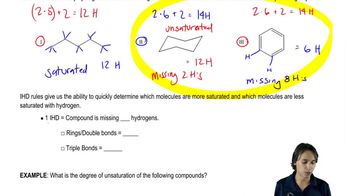
The Index of Hydrogen Deficiency (IHD) is a measure of the degree of unsaturation in a molecular formula. It indicates the number of rings and/or multiple bonds present in a compound. Each double bond or ring contributes one to the IHD, while each triple bond contributes two. The formula for calculating IHD is IHD = (2C + 2 + N - H - X) / 2, where C is the number of carbons, N is the number of nitrogens, H is the number of hydrogens, and X is the number of halogens.
추천 영상:
01:15
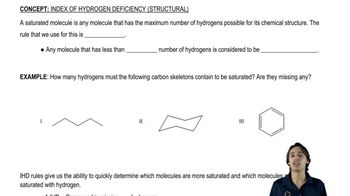
What index of hydrogen deficiency is.

Molecular Formula Interpretation

A molecular formula provides the number of each type of atom in a compound. In the case of C₉H₁₂N₂O₂, it indicates there are 9 carbon atoms, 12 hydrogen atoms, 2 nitrogen atoms, and 2 oxygen atoms. Understanding how to interpret this formula is crucial for calculating the IHD, as it directly informs the values used in the IHD formula.
추천 영상:
06:06
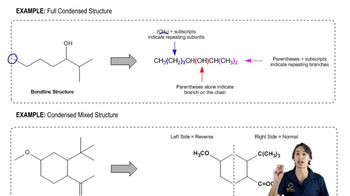
How to interpret condensed structures.

Unsaturation and Stability

Unsaturation refers to the presence of double or triple bonds in a molecule, which affects its reactivity and stability. Compounds with higher IHD values typically have more unsaturation, making them more reactive due to the presence of pi bonds. Recognizing the implications of unsaturation is important for predicting the behavior of organic compounds in chemical reactions.
추천 영상:
02:39
The difference between saturated and unsaturated molecules.