Ch. 8 - Alkenes 1: Properties and Electrophilic Additions
Mullins - Organic Chemistry: A Learner Centered Approach 1st Edition
Mullins1st EditionOrganic Chemistry: A Learner Centered ApproachISBN: 9780137566471당신이 사용하는 게 아니라요?교과서 변경
7장, 문제 68a

When using sulfuric acid, but in the absence of other nucleophiles like water or bromide ion, less stable alkenes can be isomerized to their more stable isomer. Provide a mechanism for these acid-catalyzed isomerization reactions. [This is one illustration of the principle of microscopic reversibility.]
(a)

검증된 단계별 안내
1
Step 1: Protonation of the less stable alkene - The reaction begins with the sulfuric acid (H₂SO₄) donating a proton (H⁺) to the double bond of the less stable alkene. This forms a carbocation intermediate. The protonation occurs at the less substituted carbon of the double bond, following Markovnikov's rule.
Step 2: Carbocation rearrangement - The carbocation formed in Step 1 undergoes rearrangement to form a more stable carbocation. This stability is achieved through hydride or alkyl shifts, ensuring the positive charge is located on the most substituted carbon (tertiary carbocation is more stable than secondary or primary).
Step 3: Deprotonation to form a new double bond - A base (often the bisulfate ion, HSO₄⁻, from sulfuric acid) abstracts a proton from a β-hydrogen adjacent to the carbocation. This results in the formation of a new double bond, yielding the more stable alkene isomer.
Step 4: Principle of microscopic reversibility - The reaction mechanism illustrates the principle of microscopic reversibility, where the forward and reverse reactions follow the same pathway. The acid-catalyzed isomerization ensures the equilibrium favors the formation of the more thermodynamically stable alkene.
Step 5: Final product - The more stable alkene is formed as the major product due to the thermodynamic preference for the more substituted double bond. This is evident in the provided reaction, where the initial alkene is isomerized to a more substituted and stable alkene structure.

비슷한 문제에 대한 검증된 영상 답변:

이 영상 해법은 위 문제에 도움이 된다고 튜터들이 추천한 것입니다.
영상 길이:
4m

주요 개념

질문에 올바르게 답하기 위해 반드시 이해해야 하는 핵심 개념들은 다음과 같습니다.

Acid-Catalyzed Isomerization

Acid-catalyzed isomerization involves the rearrangement of molecular structures under acidic conditions, typically facilitated by protonation of a double bond. This process allows less stable alkenes to convert into more stable isomers by overcoming energy barriers through the formation of carbocation intermediates. The presence of sulfuric acid provides protons that enhance the reactivity of the alkene, enabling the isomerization to occur.
추천 영상:
03:09
Acid Catalyzed

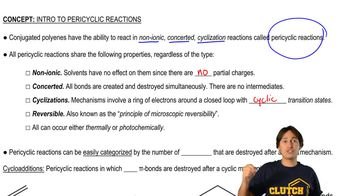
Microscopic Reversibility

Microscopic reversibility is a principle stating that the mechanism of a reaction can be reversed at the molecular level. In the context of acid-catalyzed isomerization, this means that the steps leading to the formation of a more stable isomer can also be followed in reverse to regenerate the original alkene. This concept emphasizes the symmetry in chemical reactions, where the forward and reverse pathways share similar transition states.
추천 영상:
07:37
Properties and Types of Pericyclic Reactions

Carbocation Stability

Carbocation stability is a key factor in determining the outcome of reactions involving alkenes. Carbocations are positively charged intermediates that can vary in stability based on their structure; tertiary carbocations are more stable than secondary or primary ones due to hyperconjugation and inductive effects. Understanding the stability of carbocations is crucial for predicting the favored isomerization pathway and the final product in acid-catalyzed reactions.
추천 영상:
05:58
Determining Carbocation Stability