Ch. 8 - Alkenes 1: Properties and Electrophilic Additions
Mullins - Organic Chemistry: A Learner Centered Approach 1st Edition
Mullins1st EditionOrganic Chemistry: A Learner Centered ApproachISBN: 9780137566471당신이 사용하는 게 아니라요?교과서 변경
7장, 문제 45c

Which of the following carbocations would you expect to rearrange? If you expect rearrangement, draw the carbocation you expect to form and the mechanism by which it will form.
(c) Carbocation structure showing a positive charge, illustrating potential rearrangement mechanisms in organic chemistry.

검증된 단계별 안내
1
Identify the structure of the given carbocation. Determine whether it is a primary, secondary, or tertiary carbocation, as this will influence its stability and likelihood of rearrangement.
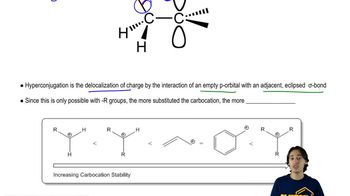
Recall the concept of carbocation rearrangement: Carbocations can undergo hydride shifts or alkyl shifts to form a more stable carbocation. Stability increases in the order: primary < secondary < tertiary < allylic < benzylic.
Examine the neighboring carbon atoms to the carbocation. Check if a hydride (H⁻) or an alkyl group (R⁻) can shift to the carbocation center to form a more stable carbocation.
If a rearrangement is possible, draw the structure of the new carbocation that forms after the shift. Ensure that the new carbocation is more stable than the original.
Illustrate the mechanism of the rearrangement. Use curved arrows to show the movement of electrons during the hydride or alkyl shift, and ensure the final structure reflects the rearranged carbocation.

비슷한 문제에 대한 검증된 영상 답변:

이 영상 해법은 위 문제에 도움이 된다고 튜터들이 추천한 것입니다.
영상 길이:
3m

주요 개념

질문에 올바르게 답하기 위해 반드시 이해해야 하는 핵심 개념들은 다음과 같습니다.

Carbocation Stability

Carbocations are positively charged carbon species that can undergo rearrangement to form more stable structures. The stability of a carbocation is influenced by factors such as the degree of substitution (primary, secondary, tertiary) and resonance. Tertiary carbocations are generally the most stable due to hyperconjugation and inductive effects from surrounding alkyl groups.
추천 영상:
05:58
Determining Carbocation Stability

Rearrangement Mechanisms

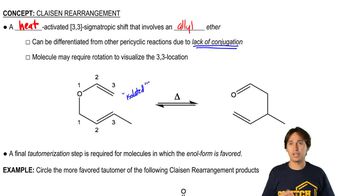
Carbocation rearrangements typically occur through two main mechanisms: hydride shifts and alkyl shifts. A hydride shift involves the movement of a hydrogen atom with its bonding electrons to the positively charged carbon, while an alkyl shift involves the migration of an alkyl group. These shifts allow the carbocation to achieve a more stable configuration, often leading to the formation of a more substituted or resonance-stabilized carbocation.
추천 영상:
06:08
Definition of Claisen Rearrangement

Reaction Pathways

Understanding the reaction pathways is crucial for predicting carbocation rearrangements. The pathway includes the initial formation of the carbocation, the rearrangement step, and the final product formation. Analyzing the energy changes and intermediates involved helps in determining whether a rearrangement is favorable and what the resulting carbocation will be, guiding the drawing of the mechanism.
추천 영상:
가이드 코스
1:08
Energy Production In Biochemical Pathways Example 1