Ch. 9 - Alkenes 2: Oxidation and Reduction
Mullins - Organic Chemistry: A Learner Centered Approach 1st Edition
Mullins1st EditionOrganic Chemistry: A Learner Centered ApproachISBN: 9780137566471당신이 사용하는 게 아니라요?교과서 변경
8장, 문제 48a

In light of your answer to Assessment 9.47, predict the product of the following reactions we have seen previously where an alcohol is substituted for water.
(a)

검증된 단계별 안내
1
Step 1: Analyze the reactants and reaction conditions. The starting material is an ether with a bulky tert-butyl group and a secondary alcohol group. The reaction conditions include H2SO4 (sulfuric acid), which is a strong acid, and ethanol (CH3CH2OH), which acts as a nucleophile.
Step 2: Recognize the mechanism involved. Under acidic conditions, ethers can undergo cleavage via protonation of the oxygen atom, making it more electrophilic. This leads to the formation of a carbocation intermediate.
Step 3: Predict the protonation step. The oxygen atom in the ether is protonated by H2SO4, resulting in the formation of a good leaving group (water or an alcohol group). This sets the stage for the cleavage of the ether bond.
Step 4: Consider the carbocation stability. The tert-butyl group is highly stabilizing for carbocations due to hyperconjugation and inductive effects. Therefore, the cleavage will likely result in the formation of a tert-butyl carbocation.
Step 5: Predict the nucleophilic attack. Ethanol (CH3CH2OH) will act as a nucleophile and attack the carbocation, leading to the formation of an ether product where the tert-butyl group is bonded to the ethoxy group (CH3CH2O-).

비슷한 문제에 대한 검증된 영상 답변:

이 영상 해법은 위 문제에 도움이 된다고 튜터들이 추천한 것입니다.
영상 길이:
4m

주요 개념

질문에 올바르게 답하기 위해 반드시 이해해야 하는 핵심 개념들은 다음과 같습니다.

Alcohol Substitution Reactions

In organic chemistry, alcohols can undergo substitution reactions where the hydroxyl (-OH) group is replaced by another group, such as a halide or an alkyl group. This process often involves the activation of the alcohol, typically by protonation, to form a better leaving group. Understanding this concept is crucial for predicting the products of reactions involving alcohols.
추천 영상:
01:44
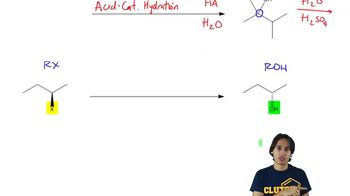
Forming alcohols through SN2 reactions.

Acid-Catalyzed Reactions

Acid-catalyzed reactions involve the use of an acid, such as sulfuric acid (H2SO4), to facilitate the reaction mechanism. In the context of alcohol substitution, the acid protonates the alcohol, enhancing its electrophilicity and making it more reactive. This concept is essential for understanding how the reaction proceeds and the role of the acid in the transformation.
추천 영상:
03:09
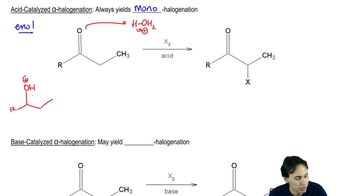
Acid Catalyzed

Mechanism of Nucleophilic Substitution

Nucleophilic substitution mechanisms, such as SN1 and SN2, describe how nucleophiles attack electrophiles to replace a leaving group. In the case of alcohol substitution, the mechanism can vary based on the structure of the substrate and the conditions of the reaction. Recognizing the type of mechanism at play helps in predicting the structure of the final product.
추천 영상:
01:47
Nucleophiles and Electrophiles can react in Substitution Reactions.