Ch.1 - Structure and Bonding
Wade - Organic Chemistry 9th Edition
Wade9th EditionOrganic ChemistryISBN: 9780135213728당신이 사용하는 게 아니라요?교과서 변경
1장, 문제 55f

Draw orbital pictures of the pi bonding in the following compounds:
f. CH3CH=NCH=C=O

검증된 단계별 안내
1
Identify the pi bonds in the compound CH3CH=NCH=C=O. The pi bonds are present in the C=N, C=C, and C=O bonds.
For each pi bond, determine the hybridization of the atoms involved. Typically, atoms involved in pi bonds are sp2 or sp hybridized, allowing for the formation of pi bonds through the overlap of unhybridized p orbitals.
Draw the molecular structure of the compound, indicating the sigma bonds first. The sigma bonds are formed by the overlap of hybridized orbitals.
For each pi bond, illustrate the side-by-side overlap of the unhybridized p orbitals. This overlap forms the pi bond, which is above and below the plane of the atoms involved in the bond.
Ensure that the pi bonds are correctly represented in the orbital diagram, showing the delocalization of electrons where applicable, especially in conjugated systems like this one.

비슷한 문제에 대한 검증된 영상 답변:

이 영상 해법은 위 문제에 도움이 된다고 튜터들이 추천한 것입니다.
영상 길이:
4m

주요 개념

질문에 올바르게 답하기 위해 반드시 이해해야 하는 핵심 개념들은 다음과 같습니다.

Pi Bonding

Pi bonds are a type of covalent bond that result from the sideways overlap of p orbitals. Unlike sigma bonds, which are formed by head-on overlap, pi bonds are formed above and below the plane of the atoms involved. They are crucial in double and triple bonds, providing additional bonding strength and influencing molecular geometry.
추천 영상:
01:05
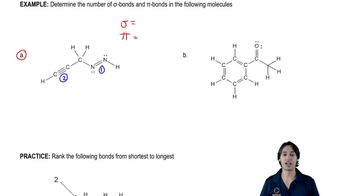
Sigma bonds and pi bonds

Orbital Hybridization

Orbital hybridization is the concept of mixing atomic orbitals to form new hybrid orbitals, which can then form sigma and pi bonds. In the context of pi bonding, understanding the hybridization state of each atom (such as sp, sp2, or sp3) helps determine the number and type of bonds an atom can form, as well as the geometry of the molecule.
추천 영상:
04:58
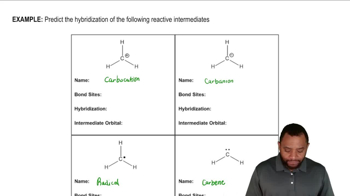
Bond sites, hybridization, and intermediate orbitals

Molecular Geometry

Molecular geometry refers to the three-dimensional arrangement of atoms within a molecule. It is determined by the number of bonds and lone pairs around a central atom, influencing the molecule's physical and chemical properties. In compounds with multiple pi bonds, geometry affects how orbitals overlap and the overall stability of the molecule.
추천 영상:
07:44
Molecular Geometry Explained.