Ch. 2 - Acids and Bases; Functional Groups
Wade - Organic Chemistry 9th Edition
Wade9th EditionOrganic ChemistryISBN: 9780135213728당신이 사용하는 게 아니라요?교과서 변경
2장, 문제 14a

Rank the following acids in decreasing order of their acid strength. In each case, explain why the previous compound should be a stronger acid than the one that follows it.

검증된 단계별 안내
1
Identify the substituents on each acid and their positions relative to the carboxylic acid group. The acids are 2-chloropropanoic acid, 2-bromopropanoic acid, 2,2-dichloropropanoic acid, and 3-bromopropanoic acid.
Understand that the acidity of carboxylic acids is influenced by the electron-withdrawing ability of substituents. Halogens like chlorine and bromine are electron-withdrawing due to their electronegativity.
Recognize that the closer the electron-withdrawing group is to the carboxylic acid group, the stronger the acid. This is due to the inductive effect, which stabilizes the negative charge on the conjugate base.
Compare the electronegativity of chlorine and bromine. Chlorine is more electronegative than bromine, making it a stronger electron-withdrawing group, thus increasing acidity.
Rank the acids based on the number and position of electron-withdrawing groups: 2,2-dichloropropanoic acid (strongest due to two chlorines), 2-chloropropanoic acid, 2-bromopropanoic acid, and 3-bromopropanoic acid (weakest due to the bromine being further from the carboxylic group).

비슷한 문제에 대한 검증된 영상 답변:

이 영상 해법은 위 문제에 도움이 된다고 튜터들이 추천한 것입니다.
영상 길이:
4m

주요 개념

질문에 올바르게 답하기 위해 반드시 이해해야 하는 핵심 개념들은 다음과 같습니다.

Acid Strength and Electronegativity

The strength of an acid is influenced by the electronegativity of the atoms attached to the acidic hydrogen. More electronegative atoms stabilize the negative charge on the conjugate base after deprotonation, making the acid stronger. For example, chlorine is more electronegative than bromine, which suggests that acids with chlorine will generally be stronger than those with bromine.
추천 영상:
1:47
Electronegativity

Resonance Stabilization

Resonance stabilization occurs when a molecule can distribute its charge over multiple atoms through delocalization. In the context of acids, if the conjugate base can stabilize the negative charge through resonance, the acid will be stronger. The presence of multiple electronegative atoms can enhance this effect, leading to increased acid strength.
추천 영상:
03:43
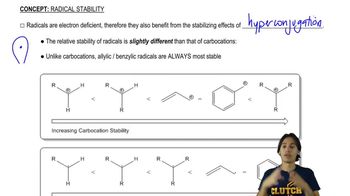
The radical stability trend.

Inductive Effect

The inductive effect refers to the electron-withdrawing or electron-donating effects of substituents on a molecule. Electron-withdrawing groups, such as halogens, can increase acid strength by stabilizing the negative charge on the conjugate base. The more electronegative the substituent, the stronger the inductive effect, which can lead to a ranking of acid strengths based on the substituents present.
추천 영상:
01:47
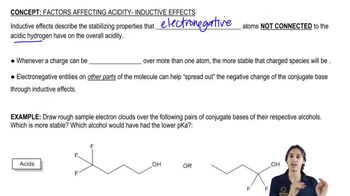
Understanding the Inductive Effect.
관련 실천
교과서 질문

Consider the type of orbitals involved, and rank the following nitrogen compounds in order of decreasing basicity. 2. Rank the conjugate acids in order of increasing acidity. (Hint: These two orders should be the same!)

1256
views

교과서 질문

Like nitrogen and carbon, oxygen also shows this same hybridization effect on acidity. Both of the following compounds can lose a proton from a positively charged oxygen with three bonds to give a conjugate base containing a neutral oxygen with two bonds. One of these structures has pKa = −2.4, while the other has pKa = −8.0.

a. Show the reaction of each compound with water.

b. Match each structure with its pKa, and explain your choice.

953
views
교과서 질문

Write equations for the following acid–base reactions. Label the conjugate acids and bases, and show any inductive stabilization. Predict whether the equilibrium favors the reactants or products. Try to do this without using a table of pKa values, but if you need a hint, you can consult Appendix 4.

g. NaOCH2CH3 + Cl2CHCH2OH

h. H2Se + NaNH2

i. CH3CHFCOOH + FCH2CH2COO–

797
views
교과서 질문

Give the structures of their conjugate acids, and estimate their pKas from similar compounds in Appendix 4.

1049
views
교과서 질문

Write equations for the following acid–base reactions. Label the conjugate acids and bases, and show any inductive stabilization. Predict whether the equilibrium favors the reactants or products. Try to do this without using a table of pKa values, but if you need a hint, you can consult Appendix 4.

j. CF3CH2O– + FCH2CH2OH

1059
views
교과서 질문

Write equations for the following acid–base reactions. Label the conjugate acids and bases, and show any inductive stabilization. Predict whether the equilibrium favors the reactants or products. Try to do this without using a table of pKa values, but if you need a hint, you can consult Appendix 4.

a. CH3CH2OH + CH3NH−

b. F3CCOONa + Br3C—COOH

c. CH3OH + H2SO4

2797
views