Ch.10 - Structure and Synthesis of Alcohols
Wade - Organic Chemistry 9th Edition
Wade9th EditionOrganic ChemistryISBN: 9780135213728당신이 사용하는 게 아니라요?교과서 변경
10장, 문제 50

Many hunting dogs enjoy standing nose-to-nose with a skunk while barking furiously, oblivious to the skunk spray directed toward them. One moderately effective way of lessening the amount of odor is to wash the dog in a bath containing dilute hydrogen peroxide, sodium bicarbonate, and some mild dish detergent. Use chemical reactions to describe how this mixture helps to remove the skunk spray from the dog. The two major components of skunk oil are 3-methylbutane-1-thiol and but-2-ene-1-thiol.

검증된 단계별 안내
1
Step 1: Identify the functional groups in the skunk spray components. Both 3-methylbutane-1-thiol and but-2-ene-1-thiol contain thiol (-SH) groups, which are responsible for the strong odor due to their high volatility and reactivity.
Step 2: Understand the role of hydrogen peroxide (H₂O₂) in the reaction. Hydrogen peroxide acts as an oxidizing agent, capable of converting thiol groups (-SH) into disulfides (-S-S-) or sulfonic acids (-SO₃H), which are less volatile and less odorous.
Step 3: Sodium bicarbonate (NaHCO₃) serves as a mild base. It helps to neutralize any acidic byproducts formed during the oxidation process and maintains a suitable pH for the reaction to proceed efficiently.
Step 4: Mild dish detergent acts as a surfactant. It helps to emulsify the oily skunk spray components, allowing them to mix with water and be washed away more effectively.
Step 5: The overall reaction involves the oxidation of the thiol groups in the skunk spray components by hydrogen peroxide, facilitated by the detergent and bicarbonate. This reduces the odor and allows the compounds to be removed from the dog's fur during washing.

비슷한 문제에 대한 검증된 영상 답변:

이 영상 해법은 위 문제에 도움이 된다고 튜터들이 추천한 것입니다.
영상 길이:
8m

주요 개념

질문에 올바르게 답하기 위해 반드시 이해해야 하는 핵심 개념들은 다음과 같습니다.

Thiol Chemistry

Thiols are organic compounds that contain a sulfhydryl group (-SH) and are known for their strong odors. The two major components of skunk spray, 3-methylbutane-1-thiol and 3-methylbut-2-ene-1-thiol, are examples of thiols. Their low molecular weight and high volatility contribute to their potent smell, making them difficult to neutralize without chemical reactions.
추천 영상:
03:21
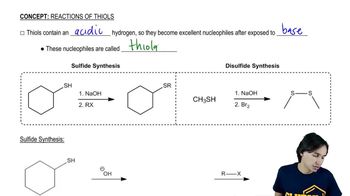
The mechanism of Sulfide Synthesis.

Oxidation-Reduction Reactions

The mixture of hydrogen peroxide and sodium bicarbonate works through oxidation-reduction reactions. Hydrogen peroxide acts as an oxidizing agent, which can convert thiols into less odorous compounds. This process reduces the thiol groups, effectively neutralizing the strong odors associated with skunk spray.
추천 영상:
00:54
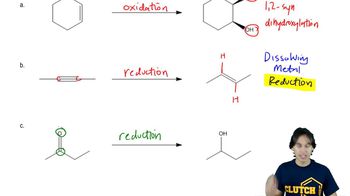
Distinguishing between Oxidation and Reduction

pH and Detergency

Sodium bicarbonate, a mild alkaline substance, helps to adjust the pH of the solution, enhancing the effectiveness of the detergent. The detergent aids in emulsifying and breaking down the oily components of skunk spray, allowing for easier removal from the dog's fur. This combination of pH adjustment and detergency is crucial for effectively cleaning the dog.
추천 영상:
02:15
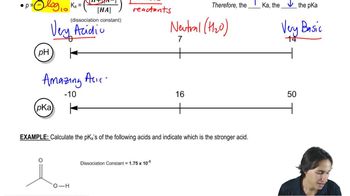
The pH scale vs. the pKa scale.