Ch.10 - Structure and Synthesis of Alcohols
Wade - Organic Chemistry 9th Edition
Wade9th EditionOrganic ChemistryISBN: 9780135213728당신이 사용하는 게 아니라요?교과서 변경
10장, 문제 22a,b,c

Predict the products of the following reactions.
(a) sec-butylmagnesium iodide + D2O
(b) n-butyllithium + CH3CH2OH
(c) isobutylmagnesium bromide + but-1-yne

검증된 단계별 안내
1
Step 1: Analyze the reactivity of the reagents in each reaction. Grignard reagents (R-MgX) and organolithium compounds (R-Li) are strong nucleophiles and bases. They react with protic solvents like D2O, CH3CH2OH, and NH3 to form hydrocarbons by proton (or deuterium) transfer.
Step 2: For reaction (a), sec-butylmagnesium iodide reacts with D2O. The Grignard reagent abstracts a deuterium atom from D2O, replacing the MgI group with a deuterium atom. The product will be sec-butyl-d (C4H9D).
Step 3: For reaction (b), n-butyllithium reacts with ethanol (CH3CH2OH). The organolithium compound abstracts a proton from ethanol, forming n-butane (C4H10) and lithium ethoxide (LiOCH2CH3).
Step 4: For reaction (c), isobutylmagnesium bromide reacts with but-1-yne. The Grignard reagent abstracts a proton from the terminal alkyne group of but-1-yne, forming isobutane (C4H10) and magnesium bromide acetylide (MgBr-C≡CH).
Step 5: Summarize the general mechanism: In each case, the organometallic reagent acts as a strong base, abstracting a proton (or deuterium) from the protic solvent or alkyne, leading to the formation of hydrocarbons and corresponding metal salts.

비슷한 문제에 대한 검증된 영상 답변:

이 영상 해법은 위 문제에 도움이 된다고 튜터들이 추천한 것입니다.
영상 길이:
7m

주요 개념

질문에 올바르게 답하기 위해 반드시 이해해야 하는 핵심 개념들은 다음과 같습니다.

Organometallic Reagents

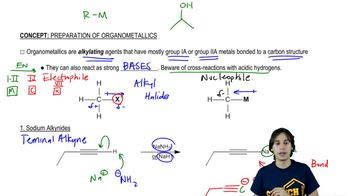
Organometallic reagents, such as Grignard reagents (RMgX) and organolithium compounds (RLi), are highly reactive species that contain a carbon-metal bond. They act as nucleophiles in organic reactions, capable of attacking electrophiles like carbonyls or halides. Understanding their reactivity is crucial for predicting the products of reactions involving these compounds.
추천 영상:
02:50
Ruining Organometallics

Reactions with Water and Alcohols

Organometallic compounds react vigorously with water and alcohols, leading to the formation of hydrocarbons and the corresponding alcohol or alkane. For example, when a Grignard reagent reacts with water (or D2O), it generates an alkane and a metal hydroxide. This reaction is essential to understand as it illustrates the sensitivity of organometallics to protic solvents.
추천 영상:
가이드 코스
1:35
Metal Ion Catalysis: Water Activation Concept 1

Acidity of Alcohols

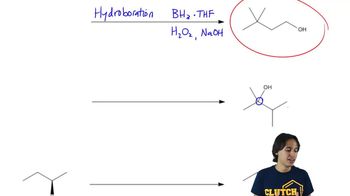
Alcohols can act as weak acids, donating protons to strong bases like organometallic reagents. In the case of n-butyllithium reacting with ethanol, the alcohol donates a proton, resulting in the formation of an alkane and a lithium alkoxide. Recognizing the acid-base behavior of alcohols is vital for predicting the outcomes of reactions involving organometallics.
추천 영상:
02:02
Forming alcohols through Acid-Catalyzed Hydration.