Ch.10 - Structure and Synthesis of Alcohols
Wade - Organic Chemistry 9th Edition
Wade9th EditionOrganic ChemistryISBN: 9780135213728당신이 사용하는 게 아니라요?교과서 변경
10장, 문제 34a

Predict which member of each pair is more acidic, and explain the reasons for your predictions.
a. cyclopentanol or 3-chlorophenol

검증된 단계별 안내
1
Step 1: Recall the general principle of acidity. Acidity is influenced by the stability of the conjugate base formed after the proton (H⁺) is lost. A more stable conjugate base corresponds to a stronger acid.
Step 2: Analyze the structure of cyclopentanol. Cyclopentanol is a cyclic alcohol with no electron-withdrawing groups. When it loses a proton, the resulting conjugate base (cyclopentoxide ion) is stabilized only by the negative charge on the oxygen atom, with no additional stabilization from resonance or inductive effects.
Step 3: Analyze the structure of 3-chlorophenol. 3-Chlorophenol is a phenol derivative with a chlorine atom attached to the benzene ring at the meta position. When it loses a proton, the resulting conjugate base (3-chlorophenoxide ion) is stabilized by resonance delocalization of the negative charge across the aromatic ring. Additionally, the chlorine atom exerts an inductive electron-withdrawing effect, further stabilizing the conjugate base.
Step 4: Compare the conjugate bases. The conjugate base of 3-chlorophenol is more stabilized due to resonance and the inductive effect of the chlorine atom, whereas the conjugate base of cyclopentanol lacks these stabilizing factors.
Step 5: Conclude that 3-chlorophenol is more acidic than cyclopentanol because its conjugate base is more stable due to resonance and inductive effects.

비슷한 문제에 대한 검증된 영상 답변:

이 영상 해법은 위 문제에 도움이 된다고 튜터들이 추천한 것입니다.
영상 길이:
7m

주요 개념

질문에 올바르게 답하기 위해 반드시 이해해야 하는 핵심 개념들은 다음과 같습니다.

Acidity and pKa

Acidity in organic chemistry refers to the tendency of a compound to donate a proton (H+). The strength of an acid is often measured by its pKa value; lower pKa values indicate stronger acids. Understanding the relationship between structure and acidity is crucial, as factors like electronegativity and resonance can significantly influence a compound's ability to stabilize the negative charge of its conjugate base.
추천 영상:
07:45
Identifying pKa values

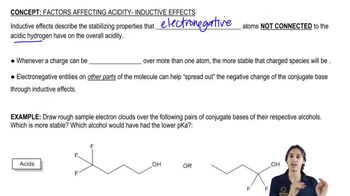
Inductive Effect

The inductive effect describes how the presence of electronegative atoms or groups can influence the acidity of a compound by stabilizing the negative charge on the conjugate base. In the case of 3-chlorophenol, the chlorine atom exerts a -I (negative inductive) effect, which helps to stabilize the phenoxide ion formed after deprotonation, making it more acidic compared to cyclopentanol.
추천 영상:
01:47
Understanding the Inductive Effect.

Resonance Stabilization

Resonance stabilization occurs when a conjugate base can delocalize its negative charge over multiple atoms, enhancing its stability. In 3-chlorophenol, the phenoxide ion can distribute the negative charge across the aromatic ring, further stabilizing it. This resonance effect contributes to the increased acidity of 3-chlorophenol compared to cyclopentanol, which lacks such stabilization.
추천 영상:
03:43
The radical stability trend.