Ch.10 - Structure and Synthesis of Alcohols
Wade - Organic Chemistry 9th Edition
Wade9th EditionOrganic ChemistryISBN: 9780135213728당신이 사용하는 게 아니라요?교과서 변경
10장, 문제 16

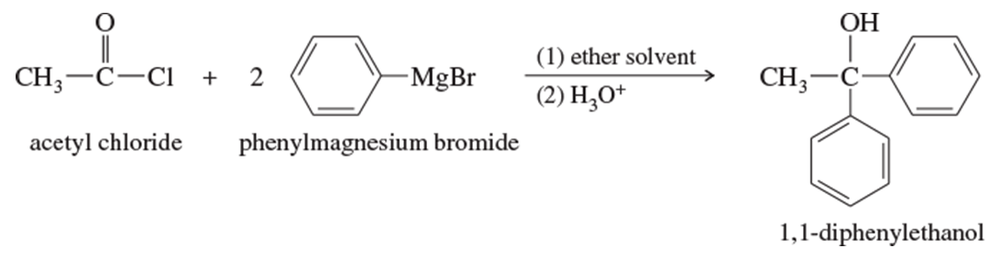
Propose a mechanism for the reaction of acetyl chloride with phenylmagnesium bromide to give 1,1-diphenylethanol.

검증된 단계별 안내
1
Step 1: Identify the reactants and the product. Acetyl chloride (CH₃COCl) reacts with phenylmagnesium bromide (C₆H₅MgBr) in an ether solvent, followed by hydrolysis with H₃O⁺, to form 1,1-diphenylethanol.
Step 2: Recognize the role of phenylmagnesium bromide as a Grignard reagent. Grignard reagents are nucleophiles that attack electrophilic carbon atoms, such as the carbonyl carbon in acetyl chloride.
Step 3: The first phenylmagnesium bromide molecule attacks the carbonyl carbon of acetyl chloride, breaking the π bond of the C=O group. This forms a tetrahedral intermediate with a negatively charged oxygen atom and a phenyl group attached to the carbon.
Step 4: The chloride ion (Cl⁻) leaves as a good leaving group, resulting in the formation of a ketone intermediate, acetophenone (C₆H₅COCH₃).
Step 5: The second phenylmagnesium bromide molecule attacks the carbonyl carbon of the ketone intermediate, forming another tetrahedral intermediate. Upon hydrolysis with H₃O⁺, the negatively charged oxygen is protonated, yielding the final product, 1,1-diphenylethanol.

비슷한 문제에 대한 검증된 영상 답변:

이 영상 해법은 위 문제에 도움이 된다고 튜터들이 추천한 것입니다.
영상 길이:
4m

주요 개념

질문에 올바르게 답하기 위해 반드시 이해해야 하는 핵심 개념들은 다음과 같습니다.

Nucleophilic Addition

Nucleophilic addition is a fundamental reaction mechanism in organic chemistry where a nucleophile attacks an electrophilic carbon atom, leading to the formation of a new bond. In this case, phenylmagnesium bromide acts as a nucleophile, attacking the carbonyl carbon of acetyl chloride, which is an electrophile due to the polarization of the carbon-oxygen double bond.
추천 영상:
08:27
Nucleophilic Addition

Grignard Reagents

Grignard reagents, such as phenylmagnesium bromide, are organomagnesium compounds that are highly reactive and serve as strong nucleophiles. They can react with various electrophiles, including carbonyl compounds, to form alcohols. Understanding their reactivity is crucial for predicting the outcome of reactions involving these reagents.
추천 영상:
02:12
Carbonation of Grignard Reagents

Protonation of Alkoxide

After the nucleophilic addition of phenylmagnesium bromide to acetyl chloride, an alkoxide intermediate is formed. This intermediate is then protonated, typically by adding water or an acid, to yield the final alcohol product, 1,1-diphenylethanol. This step is essential for converting the alkoxide into a stable alcohol.
추천 영상:
03:
Proton Splitting