Ch.10 - Structure and Synthesis of Alcohols
Wade - Organic Chemistry 9th Edition
Wade9th EditionOrganic ChemistryISBN: 9780135213728당신이 사용하는 게 아니라요?교과서 변경
10장, 문제 41a

Show how you would synthesize the following:
a. 2-phenylethanol by the addition of formaldehyde to a suitable Grignard reagent

검증된 단계별 안내
1
Step 1: Identify the target molecule, 2-phenylethanol, and recognize that it contains a benzene ring attached to a two-carbon chain ending in an alcohol group (-OH). This suggests the use of a Grignard reagent to form the carbon-carbon bond and introduce the alcohol functionality.
Step 2: Select a suitable Grignard reagent. To synthesize 2-phenylethanol, the Grignard reagent should contain a phenyl group (C₆H₅) attached to magnesium bromide (C₆H₅MgBr). This reagent will act as a nucleophile in the reaction.
Step 3: Prepare the electrophile, formaldehyde (HCHO). Formaldehyde is a simple aldehyde that will react with the Grignard reagent to form the desired alcohol. The carbonyl group in formaldehyde is highly electrophilic, making it suitable for this reaction.
Step 4: Perform the reaction. Add the Grignard reagent (C₆H₅MgBr) to formaldehyde (HCHO) in an anhydrous ether solvent under controlled conditions. The nucleophilic phenyl group attacks the electrophilic carbonyl carbon of formaldehyde, forming a new carbon-carbon bond and generating an intermediate alkoxide.
Step 5: Protonate the intermediate. After the reaction, add a dilute acid (e.g., HCl or H₂O) to protonate the alkoxide intermediate, converting it into the final product, 2-phenylethanol (C₆H₅CH₂CH₂OH).

비슷한 문제에 대한 검증된 영상 답변:

이 영상 해법은 위 문제에 도움이 된다고 튜터들이 추천한 것입니다.
영상 길이:
3m

주요 개념

질문에 올바르게 답하기 위해 반드시 이해해야 하는 핵심 개념들은 다음과 같습니다.

Grignard Reagents

Grignard reagents are organomagnesium compounds that are highly reactive and used in organic synthesis. They are formed by reacting an alkyl or aryl halide with magnesium metal in dry ether. Grignard reagents act as nucleophiles, attacking electrophiles such as carbonyl compounds, which allows for the formation of alcohols upon hydrolysis.
추천 영상:
02:12
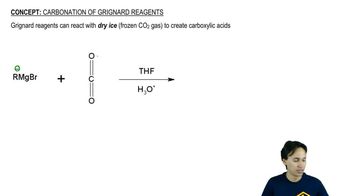
Carbonation of Grignard Reagents

Nucleophilic Addition

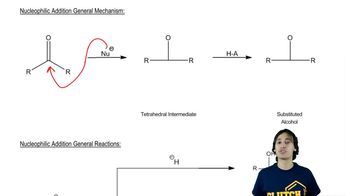
Nucleophilic addition is a fundamental reaction mechanism in organic chemistry where a nucleophile attacks an electrophilic carbon atom, typically found in carbonyl groups. In the case of synthesizing 2-phenylethanol, the Grignard reagent acts as the nucleophile, adding to the carbonyl carbon of formaldehyde, leading to the formation of an alcohol after subsequent protonation.
추천 영상:
08:27
Nucleophilic Addition

Synthesis of Alcohols

The synthesis of alcohols from carbonyl compounds is a key transformation in organic chemistry. This process often involves the reduction of aldehydes or ketones, where the addition of a nucleophile (like a Grignard reagent) to the carbonyl group results in the formation of an alcohol. In this case, the reaction of formaldehyde with a suitable Grignard reagent yields 2-phenylethanol through nucleophilic addition followed by protonation.
추천 영상:
02:26
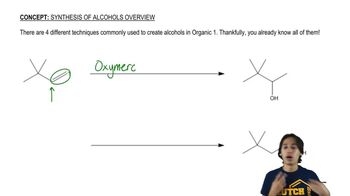
Forming alcohols through Oxymercuration-Reduction.