
Ch.10 - Structure and Synthesis of Alcohols
Wade - Organic Chemistry 9th Edition
Wade9th EditionOrganic ChemistryISBN: 9780135213728당신이 사용하는 게 아니라요?교과서 변경
10장, 문제 10a

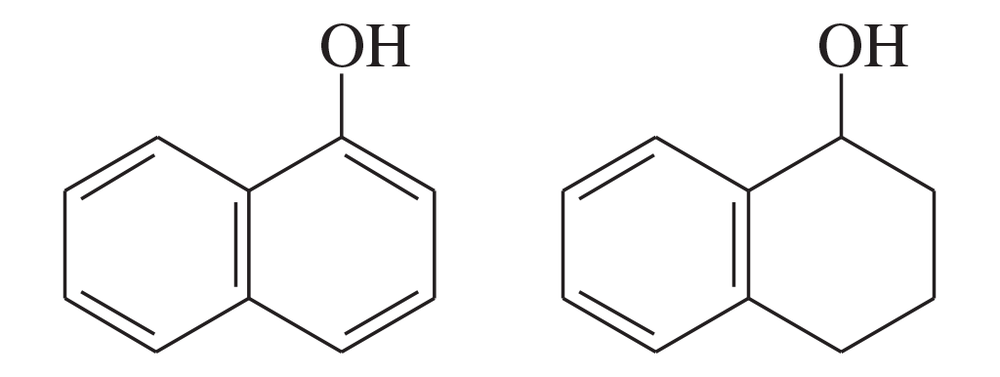
The following compounds are only slightly soluble in water, but one of them is very soluble in a dilute aqueous solution of sodium hydroxide. The other is still only slightly soluble.

(a) Explain the difference in solubility of these compounds in dilute sodium hydroxide.

검증된 단계별 안내
1
Step 1: Analyze the chemical structures of the two compounds. Compound A is cyclohexanol, which contains a hydroxyl (-OH) group attached to a saturated cyclohexane ring. Compound B is phenol, which contains a hydroxyl (-OH) group attached to an aromatic benzene ring.
Step 2: Discuss the acidity of the hydroxyl group in each compound. In phenol (Compound B), the aromatic ring stabilizes the negative charge on the oxygen atom after deprotonation due to resonance. This makes phenol more acidic compared to cyclohexanol (Compound A), which lacks resonance stabilization.
Step 3: Explain the reaction with sodium hydroxide. Phenol (Compound B), being more acidic, reacts with dilute sodium hydroxide to form phenoxide ion (C₆H₅O⁻), which is highly soluble in water. Cyclohexanol (Compound A), being less acidic, does not react significantly with sodium hydroxide and remains only slightly soluble.
Step 4: Highlight the solubility difference. The formation of the phenoxide ion increases the solubility of phenol in dilute sodium hydroxide, whereas cyclohexanol does not form a similar ion and remains slightly soluble.
Step 5: Conclude the explanation. The difference in solubility arises from the acidity of the compounds and their ability to react with sodium hydroxide. Phenol's aromatic ring allows it to form a soluble phenoxide ion, while cyclohexanol does not undergo such a reaction.

비슷한 문제에 대한 검증된 영상 답변:

이 영상 해법은 위 문제에 도움이 된다고 튜터들이 추천한 것입니다.
영상 길이:
5m

주요 개념

질문에 올바르게 답하기 위해 반드시 이해해야 하는 핵심 개념들은 다음과 같습니다.

Phenolic Compounds

Phenolic compounds are organic compounds characterized by the presence of a hydroxyl group (-OH) attached to an aromatic hydrocarbon ring. Their solubility in water can vary significantly based on the structure of the compound, particularly the presence of additional functional groups that can interact with water or other solvents.
추천 영상:
02:27
Identify the most acidic phenol

Solubility in Aqueous Solutions

The solubility of a compound in water or aqueous solutions is influenced by its ability to form hydrogen bonds and interact with water molecules. Compounds that can ionize or form strong interactions with water tend to be more soluble. In this case, the presence of sodium hydroxide can lead to deprotonation of phenolic compounds, increasing their solubility.
추천 영상:
02:01
Introducing common solvents and other molecules in organic chemistry.

Deprotonation and Ionization

Deprotonation is the removal of a proton (H+) from a molecule, which can lead to the formation of an ion. In the context of phenolic compounds, when treated with sodium hydroxide, one compound may lose its hydroxyl proton, becoming negatively charged and thus more soluble in water. The other compound may not undergo this reaction, remaining largely insoluble.
추천 영상:
04:28
Ionization Potentials
관련 실천