
Ch.11 - Reactions of Alcohols
Wade - Organic Chemistry 9th Edition
Wade9th EditionOrganic ChemistryISBN: 9780135213728당신이 사용하는 게 아니라요?교과서 변경
11장, 문제 30a,b

Predict the products formed by periodic acid cleavage of the following diols.
(a) CH3CH(OH)CH(OH)CH3
(b)

검증된 단계별 안내
1
Step 1: Understand the reaction mechanism of periodic acid (HIO4) cleavage. Periodic acid selectively cleaves vicinal diols (two hydroxyl groups on adjacent carbons) to form carbonyl compounds (aldehydes or ketones). This occurs via oxidation of the diol, breaking the C-C bond between the hydroxyl-bearing carbons.
Step 2: Analyze compound (a), CH3CH(OH)CH(OH)CH3. This is a vicinal diol with hydroxyl groups on adjacent carbons. Periodic acid will cleave the bond between the two hydroxyl-bearing carbons, resulting in two ketone products. The methyl groups on either side of the diol remain intact.
Step 3: Examine compound (b) from the image. Identify the vicinal diol structure in the molecule. The hydroxyl groups are located on adjacent carbons in the cyclic structure. Periodic acid will cleave the C-C bond between these two carbons, breaking the ring and forming two carbonyl compounds.
Step 4: Predict the products for compound (b). After cleavage, the cyclic structure opens up, and the two carbons that originally bore the hydroxyl groups are converted into carbonyl groups (aldehydes or ketones). The rest of the molecule remains unchanged.
Step 5: Summarize the periodic acid cleavage process for both compounds. For (a), the cleavage results in two ketones. For (b), the cleavage opens the ring and forms two carbonyl compounds. Ensure the products are consistent with the oxidation of vicinal diols.

비슷한 문제에 대한 검증된 영상 답변:

이 영상 해법은 위 문제에 도움이 된다고 튜터들이 추천한 것입니다.
영상 길이:
6m

주요 개념

질문에 올바르게 답하기 위해 반드시 이해해야 하는 핵심 개념들은 다음과 같습니다.

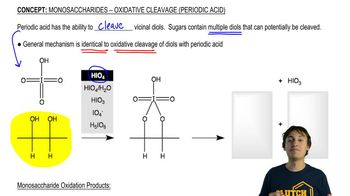
Periodic Acid Cleavage

Periodic acid (H5IO6) is a strong oxidizing agent that cleaves vicinal diols (1,2-diols) into carbonyl compounds. The reaction involves the formation of a cyclic periodate intermediate, which subsequently breaks down to yield aldehydes or ketones. Understanding this mechanism is crucial for predicting the products of diol cleavage.
추천 영상:
06:41
Monosaccharides - Oxidative Cleavage

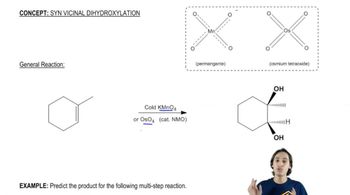
Vicinal Diols

Vicinal diols, also known as glycols, are organic compounds containing two hydroxyl (-OH) groups attached to adjacent carbon atoms. Their structure is essential for the periodic acid cleavage reaction, as the proximity of the hydroxyl groups allows for the formation of the cyclic intermediate that leads to cleavage. Recognizing the structure of the diol is key to predicting the cleavage products.
추천 영상:
03:50
General properties of syn vicinal dihydroxylation.

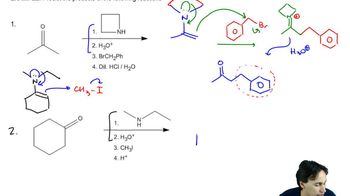
Product Prediction

Predicting the products of a chemical reaction involves understanding the reactants' structure and the reaction mechanism. In the case of periodic acid cleavage, one must identify the positions of the hydroxyl groups in the diol and apply the cleavage mechanism to determine the resulting carbonyl compounds. This skill is fundamental in organic chemistry for anticipating reaction outcomes.
추천 영상:
03:13
Predict the Products