
Ch. 12 - Infrared Spectroscopy and Mass Spectrometry
Wade - Organic Chemistry 9th Edition
Wade9th EditionOrganic ChemistryISBN: 9780135213728당신이 사용하는 게 아니라요?교과서 변경
12장, 문제 11

Account for the peaks at m/z 87, 111, and 126 in the mass spectrum of 2,6-dimethylheptan-4-ol.
<IMAGE>

검증된 단계별 안내
1
Identify the molecular structure of 2,6-dimethylheptan-4-ol. It is a seven-carbon chain with methyl groups attached to carbons 2 and 6, and a hydroxyl (-OH) group attached to carbon 4.
Understand that the mass spectrum provides peaks corresponding to fragments of the molecule. The m/z values represent the mass-to-charge ratio of these fragments, typically resulting from cleavage of bonds in the molecule.
For the peak at m/z 87: Consider the cleavage of the molecule at the C4-C5 bond. This would result in a fragment containing the first four carbons (C1-C4) along with the hydroxyl group. Calculate the mass of this fragment by summing the atomic masses of its components.
For the peak at m/z 111: Consider the cleavage of the molecule at the C3-C4 bond. This would result in a fragment containing the first three carbons (C1-C3) and the hydroxyl group, along with the methyl group at C2. Calculate the mass of this fragment by summing the atomic masses of its components.
For the peak at m/z 126: This peak likely corresponds to the molecular ion (M+) of the compound, which represents the entire molecule with a single positive charge. Calculate the molecular mass of 2,6-dimethylheptan-4-ol by summing the atomic masses of all its atoms.

비슷한 문제에 대한 검증된 영상 답변:

이 영상 해법은 위 문제에 도움이 된다고 튜터들이 추천한 것입니다.
영상 길이:
4m

주요 개념

질문에 올바르게 답하기 위해 반드시 이해해야 하는 핵심 개념들은 다음과 같습니다.

Mass Spectrometry

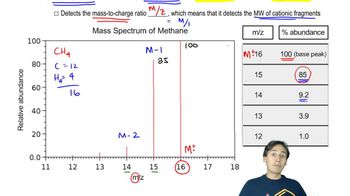
Mass spectrometry is an analytical technique used to measure the mass-to-charge ratio of ions. It involves ionizing chemical species and sorting the ions based on their mass. The resulting mass spectrum displays peaks corresponding to different ions, where the m/z (mass-to-charge) values indicate the mass of the ions detected. Understanding this technique is crucial for interpreting the peaks in the spectrum.
추천 영상:
01:25
How to Read a Mass Spectrum

Fragmentation Patterns

Fragmentation patterns refer to the specific ways in which a molecule breaks apart into smaller ions during mass spectrometry. These patterns are influenced by the structure of the molecule and can provide insights into its composition. For 2,6-dimethylheptan-4-ol, the peaks at m/z 87, 111, and 126 likely correspond to specific fragments resulting from the cleavage of the molecular structure, which can help identify the compound.
추천 영상:
08:06
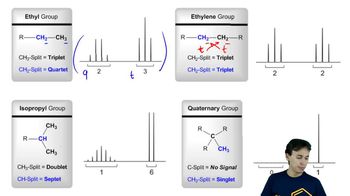
Common Splitting Patterns

Isomerism in Organic Compounds

Isomerism is the phenomenon where compounds with the same molecular formula have different structural arrangements or spatial orientations. In the case of 2,6-dimethylheptan-4-ol, understanding its isomers is essential for interpreting the mass spectrum, as different isomers can produce distinct fragmentation patterns and thus different m/z values. This concept aids in predicting and rationalizing the observed peaks in the mass spectrum.
추천 영상:
01:40
Defining meso compounds.