
Ch. 13 - Nuclear Magnetic Resonance Spectroscopy
Wade - Organic Chemistry 9th Edition
Wade9th EditionOrganic ChemistryISBN: 9780135213728당신이 사용하는 게 아니라요?교과서 변경
13장, 문제 28

The standard 13C NMR spectrum of phenyl propanoate is shown here. Predict the appearance of the DEPT-90 and DEPT-135 spectra.
<IMAGE>

검증된 단계별 안내
1
Step 1: Analyze the standard 13C NMR spectrum provided. Each peak corresponds to a unique carbon environment in phenyl propanoate. The labeled carbons (a, b, c, d, e, f, g, h) represent different chemical environments, including aromatic carbons, ester carbons, and alkyl carbons.
Step 2: Understand DEPT spectra. DEPT-90 shows only CH carbons, while DEPT-135 distinguishes CH and CH3 carbons (positive peaks) from CH2 carbons (negative peaks). Quaternary carbons (no hydrogens attached) do not appear in DEPT spectra.
Step 3: Identify the carbon types in phenyl propanoate. For example, carbon 'd' (carbonyl carbon) is quaternary and will not appear in DEPT spectra. Carbon 'a' (CH3) will appear as a positive peak in DEPT-135. Carbon 'b' (CH2) will appear as a negative peak in DEPT-135. Aromatic carbons (e, f, g, h) are CH carbons and will appear in both DEPT-90 and DEPT-135 as positive peaks.
Step 4: Predict the DEPT-90 spectrum. Only CH carbons will appear, so peaks corresponding to carbons e, f, g, and h will be visible. Other carbons (a, b, c, d) will not appear.
Step 5: Predict the DEPT-135 spectrum. Positive peaks will correspond to CH and CH3 carbons (a, e, f, g, h), while negative peaks will correspond to CH2 carbons (b). Quaternary carbons (d) will not appear.

비슷한 문제에 대한 검증된 영상 답변:

이 영상 해법은 위 문제에 도움이 된다고 튜터들이 추천한 것입니다.
영상 길이:
4m

주요 개념

질문에 올바르게 답하기 위해 반드시 이해해야 하는 핵심 개념들은 다음과 같습니다.

NMR Spectroscopy

Nuclear Magnetic Resonance (NMR) spectroscopy is a powerful analytical technique used to determine the structure of organic compounds. It exploits the magnetic properties of certain nuclei, such as carbon-13, to provide information about the number and environment of atoms in a molecule. The resulting spectra reveal details about the molecular framework, including the types of hydrogen and carbon present.
추천 영상:
10:06
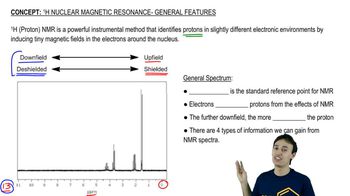
General NMR Features

DEPT NMR Techniques

DEPT (Distortionless Enhancement by Polarization Transfer) is a specialized NMR technique that enhances the detection of specific types of carbon atoms in a molecule. DEPT-90 selectively shows only CH (methine) carbons, while DEPT-135 displays CH and CH3 (methyl) carbons as positive signals and CH2 (methylene) carbons as negative signals. These techniques help in distinguishing between different carbon environments and provide clarity in interpreting the carbon skeleton.
추천 영상:
10:06
General NMR Features

Phenyl Propanoate Structure

Phenyl propanoate is an ester formed from phenol and propanoic acid, characterized by a phenyl group attached to a propanoate moiety. Understanding its structure is crucial for predicting NMR spectra, as the arrangement of carbon atoms influences the chemical shifts observed in the DEPT spectra. The presence of aromatic and aliphatic carbons in phenyl propanoate will result in distinct patterns in the DEPT-90 and DEPT-135 spectra.
추천 영상:
가이드 코스
1:45
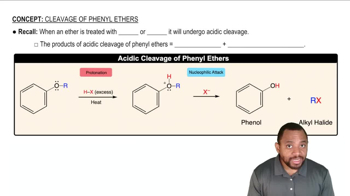
Cleavage of Phenyl Ethers Concept 1
관련 실천
교과서 질문

A bottle of allyl bromide was found to contain a large amount of an impurity. A careful distillation separated the impurity, which has the molecular formula C3H6O. The following 13C NMR spectrum of the impurity was obtained:

<IMAGE>

(a) Propose a structure for this impurity.

(b) Assign the peaks in the 13C NMR spectrum to the carbon atoms in the structure.

(c) Suggest how this impurity arose in the allyl bromide sample.

1915
views
교과서 질문

Five proton NMR spectra are given here, together with molecular formulas. In each case, propose a structure that is consistent with the spectrum.

(b) <IMAGE>

1798
views
교과서 질문

A laboratory student was converting cyclohexanol to cyclohexyl bromide by using one equivalent of sodium bromide in a large excess of concentrated sulfuric acid. The major product she recovered was not cyclohexyl bromide, but a compound of formula C6H10 that gave the following 13C NMR spectrum:

<IMAGE>

(a) Propose a structure for this product.

(b) Assign the peaks in the 13C NMR spectrum to the carbon atoms in the structure.

(c) Suggest modifications in the reaction to obtain a better yield of cyclohexyl bromide.

1817
views
교과서 질문

An inexperienced graduate student was making some 4-hydroxybutanoic acid. He obtained an excellent yield of a different compound, whose 13C NMR spectrum is shown here.

<IMAGE>

(a) Propose a structure for this product.

(b) Assign the peaks in the 13C NMR spectrum to the carbon atoms in the structure.

1794
views
교과서 질문

(b) Draw the proton NMR spectrum you would expect for butan-2-one. How well do the proton chemical shifts predict the carbon chemical shifts using the "15 to 20 times as large" rule of thumb?

1335
views
교과서 질문

(a) Show which carbon atoms correspond with which peaks in the 13C NMR spectrum of butan-2-one (Figure 13-45).

<IMAGE>

1734
views