교과서 질문
Rank each group of compounds in order of increasing heat of hydrogenation.
(b)
1542
views

 Wade 9th EditionCh. 15 - Conjugated Systems, Orbital Symmetry, and Ultraviolet Spectroscopy문제 4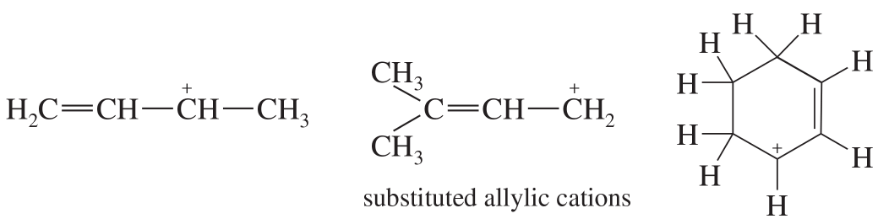
 검증된 단계별 안내

 03:04
03:04
 0:52
0:52 01:44
01:44Rank each group of compounds in order of increasing heat of hydrogenation.
(b)
When 3-bromo-1-methylcyclohexene undergoes solvolysis in hot ethanol, two products are formed. Propose a mechanism that accounts for both of these products.
Propose a mechanism for each reaction, showing explicitly how the observed mixtures of products are formed.
(b) 2-methylbut-3-en-2-ol + HBr → 1-bromo-3-methylbut-2-ene + 3-bromo-3-methylbut-1-ene
The central carbon atom of an allene is a member of two double bonds, and it has an interesting orbital arrangement that holds the two ends of the molecule at right angles to each other.
a. Draw an orbital diagram of allene, showing why the two ends are perpendicular.
b. Draw the two enantiomers of penta-2,3-diene. A model may be helpful.
Treatment of an alkyl halide with AgNO3 in alcohol often promotes ionization.
Ag+ + R–Cl → AgCl + R+
When 4-chloro-2-methylhex-2-ene reacts with AgNO3 in ethanol, two isomeric ethers are formed. Suggest structures, and propose a mechanism for their formation
In a strongly acidic solution, cyclohexa-1,4-diene tautomerizes to cyclohexa-1,3-diene. Propose a mechanism for this rearrangement, and explain why it is energetically favorable.