Ch. 15 - Conjugated Systems, Orbital Symmetry, and Ultraviolet Spectroscopy
Wade - Organic Chemistry 9th Edition
Wade9th EditionOrganic ChemistryISBN: 9780135213728당신이 사용하는 게 아니라요?교과서 변경
15장, 문제 30a

Predict the products of the following proposed Diels–Alder reactions. Include stereochemistry where appropriate.
(a) Diels-Alder reaction diagram showing reactants with a double bond and a carbonyl group.

검증된 단계별 안내
1
Step 1: Identify the reactants in the Diels–Alder reaction. The diene is the conjugated system with two double bonds, and the dienophile is the molecule with one double bond and an electron-withdrawing group (in this case, the aldehyde group).
Step 2: Recall the mechanism of the Diels–Alder reaction. It is a [4+2] cycloaddition reaction where the diene contributes four π-electrons and the dienophile contributes two π-electrons to form a cyclic product.
Step 3: Analyze the stereochemistry. The Diels–Alder reaction is stereospecific, meaning the stereochemistry of the dienophile and diene will influence the stereochemistry of the product. The aldehyde group on the dienophile will determine the orientation of substituents in the product.
Step 4: Draw the cyclic product. Combine the diene and dienophile to form a six-membered ring. The new σ-bonds will form between the ends of the diene and the carbons of the dienophile's double bond. Ensure the aldehyde group is positioned correctly based on the stereochemistry.
Step 5: Confirm the regiochemistry and stereochemistry of the product. The electron-withdrawing group (aldehyde) on the dienophile will direct the reaction to form the most stable product, typically favoring endo addition (where substituents are oriented towards the newly formed π-system).

비슷한 문제에 대한 검증된 영상 답변:

이 영상 해법은 위 문제에 도움이 된다고 튜터들이 추천한 것입니다.
영상 길이:
5m

주요 개념

질문에 올바르게 답하기 위해 반드시 이해해야 하는 핵심 개념들은 다음과 같습니다.

Diels–Alder Reaction

The Diels–Alder reaction is a [4+2] cycloaddition reaction between a conjugated diene and a dienophile, resulting in the formation of a six-membered ring. This reaction is a key method in organic synthesis for constructing cyclic compounds and is characterized by its stereospecificity, meaning the stereochemistry of the reactants is preserved in the products.
추천 영상:
04:02
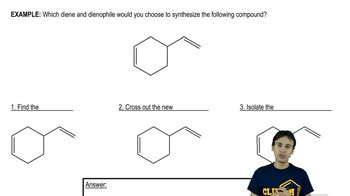
Diels-Alder Retrosynthesis

Stereochemistry

Stereochemistry refers to the study of the spatial arrangement of atoms in molecules and how this affects their chemical behavior. In the context of the Diels–Alder reaction, understanding stereochemistry is crucial for predicting the configuration of the product, as the reaction can lead to the formation of chiral centers and specific stereoisomers depending on the orientation of the reactants.
추천 영상:
가이드 코스
1:38
Polymer Stereochemistry Concept 1

Electron Density and Reactivity

In organic chemistry, the reactivity of molecules is often influenced by the distribution of electron density. In the Diels–Alder reaction, the diene must be electron-rich, while the dienophile is typically electron-poor, often containing electron-withdrawing groups. This difference in electron density facilitates the formation of the new sigma bonds during the cycloaddition process.
추천 영상:
07:07
Electron Counting
관련 실천
교과서 질문

Predict the products of the following proposed Diels–Alder reactions. Include stereochemistry where appropriate.

(e)

(f)

915
views

교과서 질문

A solution was prepared using 0.0010 g of an unknown steroid (of molecular weight around 255) in 100 mL of ethanol. Some of this solution was placed in a 1-cm cell, and the UV spectrum was measured. This solution was found to have λmax = 235 nm, with A = 0.74.

(a) Compute the value of the molar absorptivity at 235 nm.

(b) Which of the following compounds might give this spectrum?

1057
views
교과서 질문

The diene lactone shown in part (a) has one electron-donating group (-OR) and one electron-withdrawing group (C=O). This diene lactone is sufficiently electron-rich to serve as the diene in a Diels–Alder reaction.


b. The Diels–Alder product A is not very stable. Upon mild heating, it reacts to produce CO2 gas and methyl benzoate (PhCOOCH3), a very stable product. Explain how this strongly exothermic decarboxylation takes place. (Hint: Under the right conditions, the Diels–Alder reaction can be reversible.)

920
views
교과서 질문

Draw the important resonance contributors for the following cations, anions, and radicals.

(e)

(f)

757
views
교과서 질문

Predict the products of the following proposed Diels–Alder reactions. Include stereochemistry where appropriate.

(a)

(b)

(c)

1826
views
교과서 질문

Predict the products of the following proposed Diels–Alder reactions. Include stereochemistry where appropriate.

(d)

1544
views