Match four of the following UV absorption maxima (λmax) with the corresponding compounds: (1) 232 nm; (2) 256 nm; (3) 273 nm; (4) 292 nm; (5) 313 nm; (6) 353 nm.
Ch. 15 - Conjugated Systems, Orbital Symmetry, and Ultraviolet Spectroscopy
모든 교과서
Wade 9th Edition
Ch. 15 - Conjugated Systems, Orbital Symmetry, and Ultraviolet Spectroscopy
문제 25a
Wade 9th Edition
Ch. 15 - Conjugated Systems, Orbital Symmetry, and Ultraviolet Spectroscopy
문제 25a15장, 문제 25a
Predict the products of the following reactions.
(a) allyl bromide + cyclohexyl magnesium bromide
검증된 단계별 안내1
Identify the type of reaction: This reaction involves an organometallic reagent (cyclohexyl magnesium bromide, a Grignard reagent) and an alkyl halide (allyl bromide). Grignard reagents typically act as nucleophiles in reactions with electrophiles.
Analyze the reactivity of the Grignard reagent: The cyclohexyl magnesium bromide contains a cyclohexyl group bonded to magnesium. The carbon attached to magnesium is highly nucleophilic due to the polar carbon-magnesium bond.
Determine the electrophilic site in allyl bromide: In allyl bromide, the carbon bonded to the bromine atom is electrophilic because bromine is more electronegative and withdraws electron density from the carbon.
Predict the nucleophilic attack: The nucleophilic cyclohexyl group from the Grignard reagent will attack the electrophilic carbon of allyl bromide, displacing the bromide ion (Br⁻) as a leaving group. This results in the formation of a new carbon-carbon bond.
Write the product structure: The product will be an alkane where the cyclohexyl group is bonded to the allyl group (CH₂=CH-CH₂). The bromide ion (Br⁻) is a byproduct of the reaction.

비슷한 문제에 대한 검증된 영상 답변:
이 영상 해법은 위 문제에 도움이 된다고 튜터들이 추천한 것입니다.
영상 길이:
2m주요 개념
질문에 올바르게 답하기 위해 반드시 이해해야 하는 핵심 개념들은 다음과 같습니다.
Nucleophilic Substitution
Nucleophilic substitution is a fundamental reaction in organic chemistry where a nucleophile attacks an electrophile, resulting in the replacement of a leaving group. In the case of allyl bromide, the bromine atom acts as a leaving group, allowing the nucleophile (cyclohexyl magnesium bromide) to form a new bond with the carbon atom that was previously bonded to bromine.
추천 영상:
Nucleophiles and Electrophiles can react in Substitution Reactions.
Grignard Reagents
Grignard reagents are organomagnesium compounds that act as strong nucleophiles in organic reactions. Cyclohexyl magnesium bromide is a Grignard reagent that can react with electrophiles, such as allyl bromide, to form new carbon-carbon bonds. This reaction is crucial for building complex organic molecules and is a key tool in synthetic organic chemistry.
추천 영상:
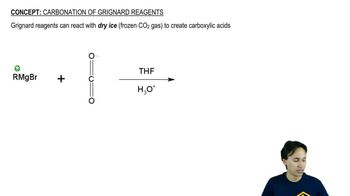
Carbonation of Grignard Reagents
Reaction Mechanism
Understanding the reaction mechanism is essential for predicting the products of organic reactions. In this case, the mechanism involves the nucleophilic attack of the Grignard reagent on the allyl bromide, leading to the formation of a new carbon-carbon bond. Analyzing the mechanism helps in anticipating the structure of the final product and understanding the steps involved in the reaction.
추천 영상:
Heck Reaction Mechanism
관련 실천
교과서 질문
1796
views
교과서 질문
Predict the products of the following reactions.
(b) cyclopentadiene + anhydrous HCl
1777
views
교과서 질문
Predict the products of the following reactions.
(c) 2-methylpropene + NBS, light
2388
views
교과서 질문
Phenolphthalein is an acid–base indicator that is colorless below pH 8 and red above pH 8. Explain briefly why the first structure is colorless and the second structure is colored.
1009
views
교과서 질문
Predict the products of the following reactions.
(d) furan + trans-1,2-dicyanoethylene
2074
views
1
rank
교과서 질문
Classify the following dienes and polyenes as isolated, conjugated, cumulated, or some combination of these classifications.
(a) cycloocta-1,4-diene
(b) cycloocta-1,3-diene
(c) cyclodeca-1,2-diene
(d) cycloocta-1,3,5,7-tetraene
(e) cyclohexa-1,3,5-triene (benzene)
(f) penta-1,2,4-triene
2417
views