Ch. 16 - Aromatic Compounds
Wade - Organic Chemistry 9th Edition
Wade9th EditionOrganic ChemistryISBN: 9780135213728당신이 사용하는 게 아니라요?교과서 변경
16장, 문제 4

Show the product of the Diels–Alder dimerization of cyclobutadiene. (This reaction is similar to the dimerization of cyclopentadiene, discussed in Section 15-11.)

검증된 단계별 안내
1
Identify the reactants: Cyclobutadiene is the diene in this reaction. It is a highly reactive compound due to its antiaromaticity (4π electrons). The Diels–Alder reaction involves a diene and a dienophile, but in this case, cyclobutadiene acts as both the diene and the dienophile.
Analyze the reaction mechanism: The Diels–Alder reaction is a [4+2] cycloaddition, where four π-electrons from the diene interact with two π-electrons from the dienophile to form a new six-membered ring. Cyclobutadiene will react with another molecule of itself to form a dimer.
Draw the interaction: Orient one molecule of cyclobutadiene as the diene (with conjugated double bonds) and the other as the dienophile (with one double bond acting as the π-system). The π-electrons from the diene will overlap with the π-electrons of the dienophile.
Predict the product: The reaction will result in the formation of a bicyclic compound. Specifically, the product will be a bicyclo[2.2.0]hexadiene structure, where the two cyclobutadiene units are fused together to form a six-membered ring with two double bonds.
Verify stereochemistry and stability: Since cyclobutadiene is highly reactive and unstable, the dimerization helps relieve some of the antiaromaticity. Ensure that the product structure is consistent with the rules of the Diels–Alder reaction and that all bonds are correctly formed.

비슷한 문제에 대한 검증된 영상 답변:

이 영상 해법은 위 문제에 도움이 된다고 튜터들이 추천한 것입니다.
영상 길이:
3m

주요 개념

질문에 올바르게 답하기 위해 반드시 이해해야 하는 핵심 개념들은 다음과 같습니다.

Diels–Alder Reaction

The Diels–Alder reaction is a [4+2] cycloaddition reaction between a conjugated diene and a dienophile, resulting in the formation of a six-membered ring. This reaction is characterized by its stereospecificity and is widely used in organic synthesis to create complex cyclic structures. Understanding the mechanism involves recognizing the roles of electron-rich and electron-poor species in the reaction.
추천 영상:
04:02
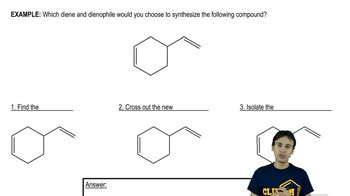
Diels-Alder Retrosynthesis

Cyclobutadiene

Cyclobutadiene is a four-membered cyclic compound with alternating double bonds, making it a highly reactive diene. Due to its antiaromatic nature, it is unstable and tends to dimerize or undergo other reactions quickly. Its behavior in the Diels–Alder reaction is significant because it can act as a diene, leading to the formation of larger cyclic products.
추천 영상:
가이드 코스
2:00
The UV-Vis Spectroscopy Example 2

Dimerization

Dimerization refers to the process where two identical molecules combine to form a dimer, which is a larger compound. In the context of cyclobutadiene, dimerization can occur through the Diels–Alder reaction, resulting in a stable product from two reactive diene units. This concept is crucial for predicting the outcome of reactions involving unstable intermediates like cyclobutadiene.
추천 영상:
04:16
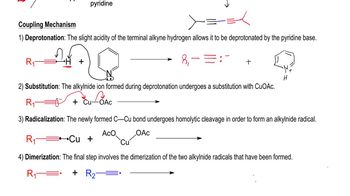
Eglinton Reaction