Ch. 17 - Reactions of Aromatic Compounds
Wade - Organic Chemistry 9th Edition
Wade9th EditionOrganic ChemistryISBN: 9780135213728당신이 사용하는 게 아니라요?교과서 변경
17장, 문제 17c

Predict the products (if any) of the following reactions.
a. (excess) benzene + isobutyl chloride + AlCl3

검증된 단계별 안내
1
Step 1: Recognize the reaction type. This is a Friedel-Crafts alkylation reaction, where an alkyl halide reacts with an aromatic compound (benzene) in the presence of a Lewis acid catalyst (AlCl3 or FeCl3).
Step 2: Understand the role of the catalyst. FeCl3 acts as a Lewis acid, accepting a lone pair from the chlorine atom in isobutyl chloride, forming a carbocation intermediate.
Step 3: Analyze the carbocation formation. Isobutyl chloride forms a primary carbocation initially, but due to carbocation rearrangement, it will rearrange to a more stable tertiary carbocation.
Step 4: Predict the electrophilic substitution. The tertiary carbocation acts as the electrophile and reacts with benzene, leading to the formation of an alkylbenzene product. The benzene ring donates electrons to the carbocation, forming a sigma complex, which then loses a proton to restore aromaticity.
Step 5: Consider the excess benzene. Since benzene is in excess, the reaction will likely produce a mono-substituted product (tert-butylbenzene) rather than polysubstitution, as steric hindrance prevents further substitution.

비슷한 문제에 대한 검증된 영상 답변:

이 영상 해법은 위 문제에 도움이 된다고 튜터들이 추천한 것입니다.
영상 길이:
4m

주요 개념

질문에 올바르게 답하기 위해 반드시 이해해야 하는 핵심 개념들은 다음과 같습니다.

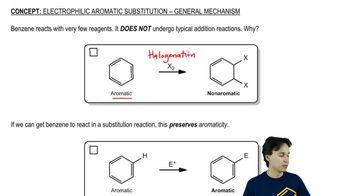
Electrophilic Aromatic Substitution (EAS)

Electrophilic Aromatic Substitution is a fundamental reaction in organic chemistry where an electrophile replaces a hydrogen atom on an aromatic ring. In this process, the aromatic system retains its stability while allowing for the introduction of new substituents. The reaction typically involves the formation of a sigma complex, followed by deprotonation to restore aromaticity.
추천 영상:
03:07
EAS Review

Lewis Acids and Catalysis

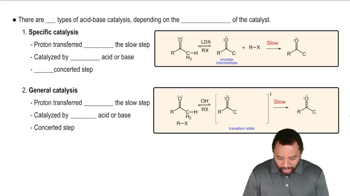
Lewis acids, such as AlCl3, are compounds that can accept an electron pair from a Lewis base, facilitating reactions by generating more reactive electrophiles. In the context of EAS, AlCl3 activates alkyl halides like isobutyl chloride, allowing them to form a more potent electrophile that can effectively react with the aromatic ring. This catalytic role is crucial for enhancing the reaction rate and product yield.
추천 영상:
가이드 코스
2:50
Acid-Base Catalysis Concept 3

Regioselectivity in Substitution Reactions

Regioselectivity refers to the preference of a chemical reaction to yield one structural isomer over others when multiple possibilities exist. In EAS reactions, the nature of the substituents already present on the aromatic ring influences where new substituents will attach. For example, alkyl groups are generally ortho/para-directing, meaning they favor substitution at the ortho or para positions relative to themselves.
추천 영상:
01:34
Recognizing Substitution Reactions.