Ch. 17 - Reactions of Aromatic Compounds
Wade - Organic Chemistry 9th Edition
Wade9th EditionOrganic ChemistryISBN: 9780135213728당신이 사용하는 게 아니라요?교과서 변경
17장, 문제 7

Propose a mechanism for the bromination of ethoxybenzene to give o- and p-bromoethoxybenzene.

검증된 단계별 안내
1
Step 1: Begin by identifying the substrate, ethoxybenzene, which is an aromatic compound with an ethoxy (-OCH2CH3) group attached to the benzene ring. The ethoxy group is an electron-donating group, activating the benzene ring and directing electrophilic substitution to the ortho and para positions.
Step 2: Recognize that bromination is an electrophilic aromatic substitution reaction. The bromine molecule (Br2) reacts with a Lewis acid catalyst, such as FeBr3, to generate the electrophile, bromonium ion (Br+). This step can be represented as: Br2+FeBr3→Br++FeBr4-
Step 3: The bromonium ion (Br+) acts as the electrophile and attacks the activated benzene ring of ethoxybenzene. Due to the electron-donating nature of the ethoxy group, the ortho and para positions are more electron-rich and thus more reactive toward the electrophile. This results in the formation of a sigma complex (arenium ion) at either the ortho or para position.
Step 4: The sigma complex undergoes deprotonation at the site of substitution to restore aromaticity. A base, such as the FeBr4- anion formed earlier, abstracts the proton from the substituted carbon, regenerating the aromatic ring and yielding o-bromoethoxybenzene or p-bromoethoxybenzene.
Step 5: Conclude by noting that the reaction typically produces a mixture of ortho and para isomers, with the para isomer often being the major product due to steric hindrance at the ortho position. The final products are o-bromoethoxybenzene and p-bromoethoxybenzene.

비슷한 문제에 대한 검증된 영상 답변:

이 영상 해법은 위 문제에 도움이 된다고 튜터들이 추천한 것입니다.
영상 길이:
17m

주요 개념

질문에 올바르게 답하기 위해 반드시 이해해야 하는 핵심 개념들은 다음과 같습니다.

Electrophilic Aromatic Substitution

Electrophilic aromatic substitution (EAS) is a fundamental reaction mechanism in organic chemistry where an electrophile replaces a hydrogen atom on an aromatic ring. In the case of bromination, bromine acts as the electrophile, and the presence of activating groups, like the ethoxy group in ethoxybenzene, influences the position of substitution, favoring ortho and para products.
추천 영상:
03:07
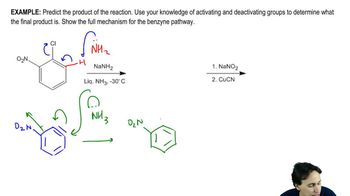
EAS Review

Resonance and Activating Groups

Resonance refers to the delocalization of electrons in a molecule, which stabilizes the structure. The ethoxy group is an electron-donating group that increases the electron density on the aromatic ring, making it more reactive towards electrophiles. This resonance effect explains why bromination occurs predominantly at the ortho and para positions relative to the ethoxy group.
추천 영상:
03:27
Activating and deactivating groups

Bromination Mechanism

The bromination mechanism involves the generation of a bromonium ion from bromine, which then reacts with the aromatic compound. The first step is the formation of the electrophile, followed by the attack of the aromatic ring, leading to the formation of a sigma complex. Finally, deprotonation restores aromaticity, yielding the bromoethoxybenzene products.
추천 영상:
00:54
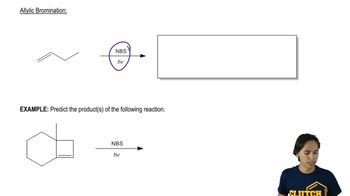
Mechanism of Allylic Bromination.