Ch. 18 - Ketones and Aldehydes
Wade - Organic Chemistry 9th Edition
Wade9th EditionOrganic ChemistryISBN: 9780135213728당신이 사용하는 게 아니라요?교과서 변경
18장, 문제 39c

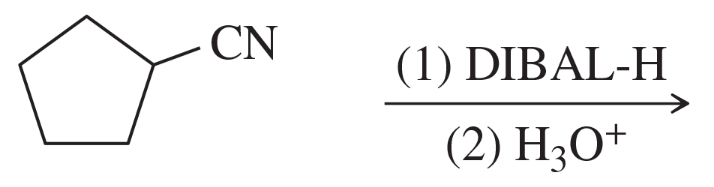
Predict the major products of the following reactions.
(c)

검증된 단계별 안내
1
Step 1: Identify the functional group in the starting material. The molecule contains a terminal alkyne group (-C≡CH). This functional group is reactive under the conditions provided.
Step 2: Recognize the reagent and its role. DIBAL-H (Diisobutylaluminum hydride) is a reducing agent that selectively reduces certain functional groups, such as esters, nitriles, and alkynes, under controlled conditions (e.g., -78°C). It is often used to stop the reduction at an intermediate stage.
Step 3: Predict the intermediate formed after the first step. DIBAL-H at low temperatures (-78°C) reduces the alkyne group to an aldehyde. This occurs because DIBAL-H selectively adds hydrogen to the triple bond, forming a double bond and introducing an oxygen atom.
Step 4: Consider the second step of the reaction. The addition of water (H₂O) in the second step is used to hydrolyze the aluminum complex formed during the reduction, yielding the final product.
Step 5: Combine the information to predict the major product. The major product of this reaction will be an aldehyde derived from the reduction of the terminal alkyne group. The cyclic structure remains intact, and the aldehyde group (-CHO) will be attached to the carbon that was part of the triple bond.

비슷한 문제에 대한 검증된 영상 답변:

이 영상 해법은 위 문제에 도움이 된다고 튜터들이 추천한 것입니다.
영상 길이:
4m

주요 개념

질문에 올바르게 답하기 위해 반드시 이해해야 하는 핵심 개념들은 다음과 같습니다.

DIBAL-H (Diisobutylaluminum Hydride)

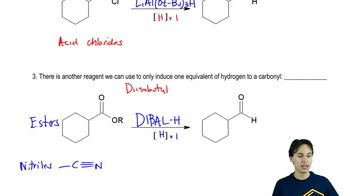
DIBAL-H is a strong reducing agent commonly used in organic chemistry to selectively reduce esters and nitriles to aldehydes. At low temperatures, such as -78°C, it allows for controlled reduction, preventing over-reduction to alcohols. Understanding its reactivity and selectivity is crucial for predicting the products of reactions involving carbonyl compounds.
추천 영상:
02:10
DIBAL-H on Esters and Nitriles

Aldehyde Formation

The reaction of DIBAL-H with an ester or nitrile typically results in the formation of an aldehyde. This occurs because DIBAL-H adds to the carbonyl carbon, leading to the formation of an intermediate that can be hydrolyzed upon the addition of water. Recognizing the mechanism of aldehyde formation is essential for predicting the major products in the given reaction.
추천 영상:
01:34
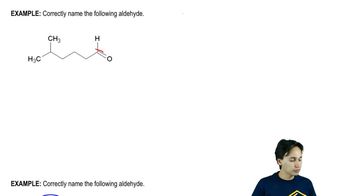
Name the aldehyde

Hydrolysis

Hydrolysis is the chemical process in which water reacts with a compound, leading to the breakdown of that compound. In the context of the reaction with DIBAL-H, the addition of water after the reduction step converts the intermediate formed into the final aldehyde product. Understanding hydrolysis is important for determining the final outcome of the reaction sequence.
추천 영상:
가이드 코스
1:00
Hydrolysis of Thioesters Concept 2