Ch. 18 - Ketones and Aldehydes
Wade - Organic Chemistry 9th Edition
Wade9th EditionOrganic ChemistryISBN: 9780135213728당신이 사용하는 게 아니라요?교과서 변경
18장, 문제 35a

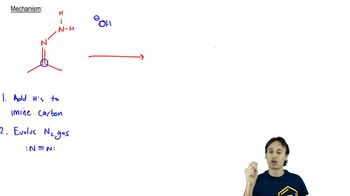
Propose a mechanism for both parts of the Wolff–Kishner reduction of cyclohexanone: the formation of the hydrazone, and then the base-catalyzed reduction with evolution of nitrogen gas.

검증된 단계별 안내
1
Step 1: Formation of the hydrazone - Start with cyclohexanone (a ketone) and hydrazine (NH₂NH₂). The carbonyl group (C=O) of cyclohexanone reacts with hydrazine in the presence of an acid catalyst. This involves nucleophilic attack by the lone pair on the nitrogen of hydrazine on the electrophilic carbon of the carbonyl group, forming a tetrahedral intermediate.
Step 2: Proton transfer - In the tetrahedral intermediate, a proton transfer occurs, leading to the elimination of water (H₂O) and the formation of a double bond between the carbon and nitrogen. This results in the formation of the hydrazone (C=N-NH₂).
Step 3: Base-catalyzed reduction - In the second part of the mechanism, the hydrazone is treated with a strong base, such as KOH, and heat. The base deprotonates the terminal nitrogen (NH₂ group), forming a resonance-stabilized anion.
Step 4: Nitrogen gas evolution - The resonance-stabilized anion undergoes further deprotonation and rearrangement, leading to the cleavage of the N-N bond and the release of nitrogen gas (N₂). This step is driven by the stability of nitrogen gas as a product.
Step 5: Formation of the alkane - The remaining carbon fragment is protonated by water or another proton source, resulting in the formation of cyclohexane, the fully reduced product.

비슷한 문제에 대한 검증된 영상 답변:

이 영상 해법은 위 문제에 도움이 된다고 튜터들이 추천한 것입니다.
영상 길이:
6m

주요 개념

질문에 올바르게 답하기 위해 반드시 이해해야 하는 핵심 개념들은 다음과 같습니다.

Wolff–Kishner Reduction

The Wolff–Kishner reduction is a chemical reaction used to convert carbonyl compounds, such as ketones and aldehydes, into alkanes. This process involves the formation of a hydrazone intermediate, which is then treated with a strong base, typically hydrazine and potassium hydroxide, to facilitate the removal of nitrogen gas and reduce the carbonyl compound.
추천 영상:
04:57
Mechanism

Formation of Hydrazone

The formation of a hydrazone occurs when a carbonyl compound reacts with hydrazine. This reaction involves the nucleophilic attack of the hydrazine on the carbonyl carbon, leading to the formation of a C=N bond. The resulting hydrazone is a key intermediate in the Wolff–Kishner reduction, which stabilizes the carbonyl compound for subsequent reduction.
추천 영상:
02:26
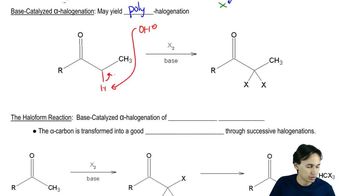
Formation of Enolates

Base-Catalyzed Reduction

In the base-catalyzed reduction step of the Wolff–Kishner reaction, the hydrazone undergoes deprotonation by a strong base, generating a reactive intermediate. This intermediate then eliminates nitrogen gas, resulting in the formation of an alkane. The evolution of nitrogen gas is a driving force for the reaction, facilitating the conversion of the hydrazone to the final hydrocarbon product.
추천 영상:
01:57
Base Catalyzed