Ch. 18 - Ketones and Aldehydes
Wade - Organic Chemistry 9th Edition
Wade9th EditionOrganic ChemistryISBN: 9780135213728당신이 사용하는 게 아니라요?교과서 변경
18장, 문제 23d

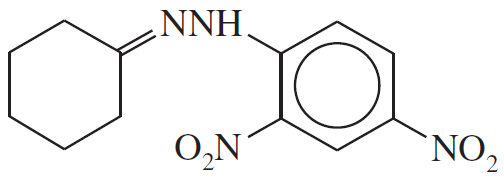
Show what amines and carbonyl compounds combine to give the following derivatives.
(d)

검증된 단계별 안내
1
Step 1: Analyze the given derivative structure. The molecule consists of a hydrazone functional group (-C=N-NH-) formed by the reaction of a carbonyl compound and a hydrazine derivative. Additionally, the hydrazine derivative contains a nitro-substituted benzene ring.
Step 2: Identify the carbonyl compound. The left side of the molecule shows a cyclohexanone structure, which is a ketone with a six-membered ring. This indicates that cyclohexanone is the carbonyl compound involved in the reaction.
Step 3: Identify the amine component. The hydrazone group suggests that the amine component is a hydrazine derivative. The right side of the molecule shows a nitro-substituted benzene ring attached to the hydrazine group. This indicates that the amine component is 2,4-dinitrophenylhydrazine.
Step 4: Understand the reaction mechanism. The reaction involves the nucleophilic attack of the hydrazine derivative (2,4-dinitrophenylhydrazine) on the carbonyl group of cyclohexanone, followed by the elimination of water to form the hydrazone derivative.
Step 5: Summarize the reactants. The amine component is 2,4-dinitrophenylhydrazine, and the carbonyl compound is cyclohexanone. These two reactants combine to form the given hydrazone derivative.

비슷한 문제에 대한 검증된 영상 답변:

이 영상 해법은 위 문제에 도움이 된다고 튜터들이 추천한 것입니다.
영상 길이:
2m

주요 개념

질문에 올바르게 답하기 위해 반드시 이해해야 하는 핵심 개념들은 다음과 같습니다.

Amines

Amines are organic compounds derived from ammonia (NH3) by replacing one or more hydrogen atoms with alkyl or aryl groups. They can be classified as primary, secondary, or tertiary based on the number of carbon-containing groups attached to the nitrogen atom. Amines are known for their basicity and nucleophilicity, making them reactive towards electrophiles, such as carbonyl compounds.
추천 영상:
07:12
Reductive Amination

Carbonyl Compounds

Carbonyl compounds contain a carbon atom double-bonded to an oxygen atom (C=O). This functional group is characteristic of aldehydes and ketones, which differ in the placement of the carbonyl group. Carbonyl compounds are polar and can act as electrophiles, making them susceptible to nucleophilic attack by amines, leading to the formation of various derivatives.
추천 영상:
01:40
Defining meso compounds.

Derivatives of Amines and Carbonyl Compounds

When amines react with carbonyl compounds, they can form derivatives such as imines and enamines. Imines are formed when a primary amine reacts with an aldehyde or ketone, resulting in a C=N bond. Enamines, on the other hand, are formed from secondary amines and involve a double bond between the carbon and nitrogen, showcasing the versatility of amines in organic synthesis.
추천 영상:
03:50
Intro to Carboxylic Acid Derivatives