


Ch. 20 - Carboxylic Acids
Wade - Organic Chemistry 9th Edition
Wade9th EditionOrganic ChemistryISBN: 9780135213728당신이 사용하는 게 아니라요?교과서 변경
20장, 문제 12b

Propose a mechanism for the acid-catalyzed reaction of acetic acid with ethanol to give ethyl acetate.

검증된 단계별 안내
1
Step 1: Protonation of the carbonyl oxygen in acetic acid: The reaction begins with the acid catalyst (e.g., H⁺) protonating the carbonyl oxygen of acetic acid. This increases the electrophilicity of the carbonyl carbon, making it more susceptible to nucleophilic attack.
Step 2: Nucleophilic attack by ethanol: The lone pair of electrons on the oxygen atom of ethanol attacks the electrophilic carbonyl carbon of the protonated acetic acid, forming a tetrahedral intermediate.
Step 3: Proton transfer: A proton transfer occurs within the intermediate to stabilize the structure. This step involves the transfer of a proton from the positively charged oxygen (from ethanol) to one of the hydroxyl groups in the intermediate.
Step 4: Elimination of water: The intermediate undergoes a dehydration step, where a water molecule is eliminated. This results in the formation of a protonated ethyl acetate intermediate.
Step 5: Deprotonation to regenerate the catalyst: The protonated ethyl acetate loses a proton (H⁺), regenerating the acid catalyst and yielding the final product, ethyl acetate.

비슷한 문제에 대한 검증된 영상 답변:

이 영상 해법은 위 문제에 도움이 된다고 튜터들이 추천한 것입니다.
영상 길이:
11m

주요 개념

질문에 올바르게 답하기 위해 반드시 이해해야 하는 핵심 개념들은 다음과 같습니다.

Acid-Catalyzed Reactions

Acid-catalyzed reactions involve the use of an acid to increase the rate of a chemical reaction. In this context, the acid donates protons (H+) to the reactants, facilitating the formation of intermediates that lead to the desired product. Understanding the role of the acid is crucial for proposing a mechanism, as it influences the reaction pathway and the stability of intermediates.
추천 영상:
03:09
Acid Catalyzed

Esterification

Esterification is a chemical reaction that forms an ester from an alcohol and a carboxylic acid, typically in the presence of an acid catalyst. In this case, acetic acid reacts with ethanol to produce ethyl acetate. Recognizing the general structure and properties of esters helps in understanding the transformation and the significance of the functional groups involved.
추천 영상:
가이드 코스
1:21
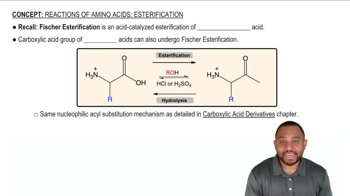
Reactions of Amino Acids: Esterification Concept 1

Reaction Mechanism

A reaction mechanism outlines the step-by-step sequence of elementary reactions that occur during a chemical transformation. For the esterification of acetic acid and ethanol, the mechanism includes protonation of the carbonyl oxygen, nucleophilic attack by ethanol, and subsequent elimination of water. Grasping the mechanism is essential for predicting the behavior of reactants and the formation of products.
추천 영상:
02:16
Heck Reaction Mechanism
관련 실천
교과서 질문

The Principle of Microscopic Reversibility states that a forward reaction and a reverse reaction taking place under the same conditions (as in an equilibrium) must follow the same reaction pathway in microscopic detail. The reverse of the Fischer esterification is the acid-catalyzed hydrolysis of an ester. Propose a mechanism for the acid-catalyzed hydrolysis of ethyl benzoate, PhCOOCH2CH3.

729
views
교과서 질문

Show how Fischer esterification might be used to form the following esters. In each case, suggest a method for driving the reaction to completion.

(a) methyl salicylate

530
views
교과서 질문

Show how you would synthesize the following carboxylic acids, using the indicated starting materials.

(e) p-xylene → terephthalic acid

681
views
교과서 질문

Show how you would synthesize the following carboxylic acids, using the indicated starting materials.

(f) allyl iodide → but-3-enoic acid

663
views
교과서 질문

A carboxylic acid has two oxygen atoms, each with two nonbonding pairs of electrons.

(a) Draw the resonance forms of a carboxylic acid that is protonated on the hydroxy oxygen atom.

(b) Compare the resonance forms with those given previously for an acid protonated on the carbonyl oxygen atom.

(c) Explain why the carbonyl oxygen atom of a carboxylic acid is more basic than the hydroxy oxygen.

1933
views
교과서 질문

Show how you would synthesize the following carboxylic acids, using the indicated starting materials.

(d) butan-2-ol → 2-methylbutanoic acid

665
views