
Suppose you have just synthesized heptanoic acid from heptan-1-ol. The product is contaminated by sodium dichromate, sulfuric acid, heptan-1-ol, and possibly heptanal. Explain how you would use acid–base extractions to purify the heptanoic acid. Use a chart, like that in Figure 20-3, to show where the impurities are at each stage.
Ch. 20 - Carboxylic Acids
20장, 문제 3a
Rank the compounds in each set in order of increasing acid strength.
(a) CH3CH2COOH, CH3CHBrCOOH, CH3CBr2COOH
검증된 단계별 안내1
Identify the functional group responsible for acidity in each compound. In this case, all compounds are carboxylic acids (R-COOH), where the acidic hydrogen is attached to the hydroxyl group (-OH) of the carboxylic acid.
Recognize that the acidity of carboxylic acids is influenced by the electron-withdrawing or electron-donating effects of substituents on the carbon chain. Electron-withdrawing groups stabilize the conjugate base (R-COO⁻) by delocalizing the negative charge, increasing acidity.
Analyze the substituents on the α-carbon (the carbon adjacent to the carboxylic acid group) for each compound: (1) CH₃CH₂COOH has no halogen substituents, (2) CH₃CHBrCOOH has one bromine atom, and (3) CH₃CBr₂COOH has two bromine atoms.
Understand that bromine is an electron-withdrawing group due to its electronegativity. The more bromine atoms present, the stronger the electron-withdrawing effect, which increases the acidity of the compound.
Rank the compounds in order of increasing acid strength based on the number of bromine atoms: CH₃CH₂COOH < CH₃CHBrCOOH < CH₃CBr₂COOH.

비슷한 문제에 대한 검증된 영상 답변:
이 영상 해법은 위 문제에 도움이 된다고 튜터들이 추천한 것입니다.
영상 길이:
5m주요 개념
질문에 올바르게 답하기 위해 반드시 이해해야 하는 핵심 개념들은 다음과 같습니다.
Acid Strength
Acid strength refers to the ability of a compound to donate protons (H+) in a solution. Stronger acids dissociate more completely in water, leading to a higher concentration of H+ ions. The strength of an acid is often influenced by the stability of its conjugate base; the more stable the conjugate base, the stronger the acid.
추천 영상:
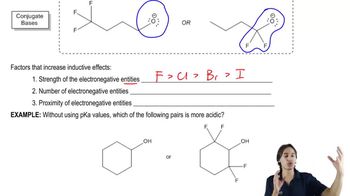
The 3 factors that determine the strength of inductive effects.
Inductive Effect
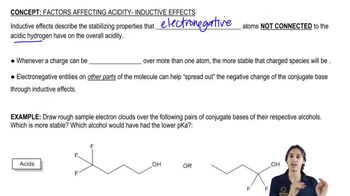
The inductive effect is the electron-withdrawing or electron-donating effect exerted by substituents on a molecule. In carboxylic acids, electronegative substituents (like Br) can stabilize the negative charge on the conjugate base through the inductive effect, thereby increasing acid strength. The greater the number of electronegative substituents, the stronger the acid.
추천 영상:
Understanding the Inductive Effect.
Carboxylic Acids
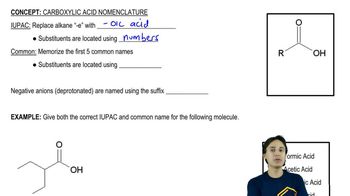
Carboxylic acids are organic compounds characterized by the presence of a carboxyl group (-COOH). Their acidity is primarily due to the ability of the carboxyl group to release a proton. The structure and substituents attached to the carbon chain can significantly influence their acid strength, making it essential to analyze these factors when ranking their acidity.
추천 영상:
Carboxylic Acids Nomenclature
관련 실천
교과서 질문
89
views
교과서 질문
Draw the structures of the following carboxylic acids.
(e) trans-2-methylcyclohexanecarboxylic acid
(f) 2,3-dimethylfumaric acid
(g) m-chlorobenzoic acid
(h) 3-methylphthalic acid
825
views
교과서 질문
Rank the compounds in each set in order of increasing acid strength.
(c)
2216
views
교과서 질문
Name the following carboxylic acids (when possible, give both a common name and a systematic name).
(a)
(b)
(c)
1458
views
교과서 질문
Rank the compounds in each set in order of increasing acid strength.
(b) CH3CH2CH2CHBrCOOH, CH3CH2CHBrCH2COOH, CH3CHBrCH2CH2COOH
1449
views
교과서 질문
Name the following carboxylic acids (when possible, give both a common name and a systematic name).
(d)
(e)
(f)
709
views
