Ch. 20 - Carboxylic Acids
Wade - Organic Chemistry 9th Edition
Wade9th EditionOrganic ChemistryISBN: 9780135213728당신이 사용하는 게 아니라요?교과서 변경
20장, 문제 19

Show how you would synthesize the following compounds from the appropriate carboxylic acids or acid derivatives.

검증된 단계별 안내
1
Step 1: For compound A, identify the target structure as a cyclopentylpropanoic acid. Start with cyclopentane and introduce a propanoic acid group using a Friedel-Crafts acylation reaction with propanoyl chloride (CH3CH2COCl) in the presence of AlCl3.
Step 2: For compound B, identify the target structure as a cyclopentenyl aldehyde. Begin with cyclopentene and perform hydroformylation using CO and H2 in the presence of a rhodium catalyst to introduce the aldehyde group.
Step 3: For compound C, identify the target structure as a cyclohexylpropanoic acid. Start with cyclohexane and introduce a propanoic acid group using a Friedel-Crafts acylation reaction with propanoyl chloride (CH3CH2COCl) in the presence of AlCl3.
Step 4: Ensure that the reaction conditions for each synthesis are optimized to avoid overreaction or side products. For example, use stoichiometric amounts of reagents and control temperature during the reactions.
Step 5: Purify the synthesized compounds using techniques such as recrystallization or distillation to isolate the desired product and confirm the structure using spectroscopic methods like NMR or IR.

비슷한 문제에 대한 검증된 영상 답변:

이 영상 해법은 위 문제에 도움이 된다고 튜터들이 추천한 것입니다.
영상 길이:
8m

주요 개념

질문에 올바르게 답하기 위해 반드시 이해해야 하는 핵심 개념들은 다음과 같습니다.

Carboxylic Acids and Derivatives

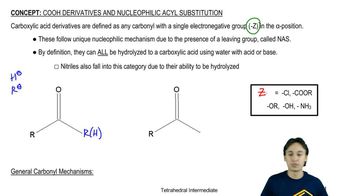
Carboxylic acids are organic compounds containing a carboxyl group (-COOH), which is crucial for various chemical reactions. Acid derivatives, such as esters, amides, and anhydrides, can be synthesized from carboxylic acids and are often more reactive. Understanding the reactivity and transformation of these compounds is essential for designing synthetic pathways to target molecules.
추천 영상:
03:50
Intro to Carboxylic Acid Derivatives

Functional Group Transformations

Functional group transformations involve converting one functional group into another through chemical reactions. This concept is vital in organic synthesis, as it allows chemists to modify the structure and properties of molecules. For example, converting a carboxylic acid to an alcohol or an ester can be achieved through specific reagents and reaction conditions, which are key to synthesizing the desired compounds A, B, and C.
추천 영상:
02:36
Identifying Functional Groups

Synthesis Strategies

Synthesis strategies refer to the systematic approach used to construct complex organic molecules from simpler precursors. This includes selecting appropriate starting materials, reaction conditions, and reagents to achieve the desired transformations. In the context of the question, identifying the correct carboxylic acids or derivatives to synthesize compounds A, B, and C requires a clear understanding of retrosynthetic analysis and the reactivity of functional groups.
추천 영상:
가이드 코스
1:16
Synthesis of Amino Acids: Strecker Synthesis Example 1