Ch. 21 - Carboxylic Acid Derivatives
Wade - Organic Chemistry 9th Edition
Wade9th EditionOrganic ChemistryISBN: 9780135213728당신이 사용하는 게 아니라요?교과서 변경
21장, 문제 6c

Propose a second mechanism for the reaction of benzoic acid with acetyl chloride to give acetic benzoic anhydride. This time, let the other oxygen of benzoic acid serve as the nucleophile to attack the carbonyl group of acetyl chloride. Because proton transfers are fast between these oxygen atoms, it is difficult to differentiate between these two mechanisms experimentally.

검증된 단계별 안내
1
Step 1: Begin by identifying the reactants and their roles. Benzoic acid (C₆H₅COOH) has two oxygen atoms: one in the hydroxyl group (-OH) and one in the carbonyl group (C=O). Acetyl chloride (CH₃COCl) contains a highly electrophilic carbonyl carbon due to the electron-withdrawing effect of the chlorine atom.
Step 2: In this proposed mechanism, the carbonyl oxygen of benzoic acid will act as the nucleophile. The lone pair of electrons on the carbonyl oxygen attacks the electrophilic carbonyl carbon of acetyl chloride, forming a tetrahedral intermediate. Represent this step as: C6H5C=O+CH3-COCl→tetrahedralintermediate.
Step 3: The tetrahedral intermediate is unstable and undergoes a rearrangement. The chloride ion (Cl⁻) is expelled as a leaving group, and a proton transfer occurs between the hydroxyl group and the newly formed oxygen atom. This step stabilizes the intermediate and forms the acetic benzoic anhydride product.
Step 4: Highlight the role of proton transfer. Proton transfers between the hydroxyl oxygen and the carbonyl oxygen of benzoic acid are fast and reversible. This makes it challenging to experimentally distinguish between this mechanism and the one where the hydroxyl oxygen acts as the nucleophile.
Step 5: Conclude by noting that both mechanisms lead to the same product, acetic benzoic anhydride. The difference lies in which oxygen atom of benzoic acid initiates the nucleophilic attack on acetyl chloride.

비슷한 문제에 대한 검증된 영상 답변:

이 영상 해법은 위 문제에 도움이 된다고 튜터들이 추천한 것입니다.
영상 길이:
3m

주요 개념

질문에 올바르게 답하기 위해 반드시 이해해야 하는 핵심 개념들은 다음과 같습니다.

Nucleophilic Acyl Substitution

Nucleophilic acyl substitution is a fundamental reaction in organic chemistry where a nucleophile attacks the electrophilic carbon of a carbonyl group, leading to the substitution of a leaving group. In the context of benzoic acid and acetyl chloride, the nucleophile (the oxygen atom of benzoic acid) attacks the carbonyl carbon of acetyl chloride, forming a tetrahedral intermediate that eventually leads to the formation of an anhydride.
추천 영상:
01:47
Nucleophiles and Electrophiles can react in Substitution Reactions.

Proton Transfer Mechanism

Proton transfer mechanisms involve the movement of protons (H⁺ ions) between atoms, which can significantly influence reaction pathways. In the proposed reaction, rapid proton transfers between the oxygen atoms of benzoic acid can complicate the identification of distinct mechanisms, as these transfers can occur before the reaction products are formed, making it challenging to track the specific roles of each oxygen atom.
추천 영상:
가이드 코스
3:05
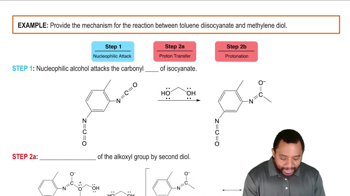
Polyurethane Mechanism Example 1

Carbonyl Reactivity

The reactivity of carbonyl compounds is a key concept in organic chemistry, as the carbonyl carbon is electrophilic and susceptible to nucleophilic attack. In the reaction between benzoic acid and acetyl chloride, the carbonyl group of acetyl chloride is particularly reactive due to the presence of the electronegative chlorine atom, which enhances the electrophilicity of the carbonyl carbon, facilitating the nucleophilic attack by the benzoic acid.
추천 영상:
04:20
Carboxylic Acids Nomenclature