Ch. 21 - Carboxylic Acid Derivatives
Wade - Organic Chemistry 9th Edition
Wade9th EditionOrganic ChemistryISBN: 9780135213728당신이 사용하는 게 아니라요?교과서 변경
21장, 문제 40

Propose a mechanism for the reaction of methyl isocyanate with 1-naphthol to give Sevin® insecticide.

검증된 단계별 안내
1
Identify the key functional groups in the reactants: Methyl isocyanate (CH3-N=C=O) contains an isocyanate group (-N=C=O), and 1-naphthol contains a hydroxyl group (-OH) attached to a naphthalene ring. These groups are crucial for the reaction mechanism.
Recognize the nucleophile and electrophile: The hydroxyl group (-OH) of 1-naphthol acts as a nucleophile due to the lone pair of electrons on oxygen, while the carbon atom in the isocyanate group (-N=C=O) is electrophilic due to its partial positive charge.
Propose the first step of the mechanism: The nucleophilic oxygen atom of the hydroxyl group attacks the electrophilic carbon atom of the isocyanate group, forming a tetrahedral intermediate. This step involves the formation of a new C-O bond.
Describe the rearrangement: The tetrahedral intermediate undergoes rearrangement, where the nitrogen atom (N) of the isocyanate group facilitates the elimination of the oxygen atom (O) as part of a leaving group, forming a carbamate linkage (-NH-COO-).
Conclude the mechanism: The final product is Sevin® insecticide, which contains a carbamate functional group (-NH-COO-) attached to the naphthalene ring. This structure is stabilized by resonance and is the desired product of the reaction.

비슷한 문제에 대한 검증된 영상 답변:

이 영상 해법은 위 문제에 도움이 된다고 튜터들이 추천한 것입니다.
영상 길이:
9m

주요 개념

질문에 올바르게 답하기 위해 반드시 이해해야 하는 핵심 개념들은 다음과 같습니다.

Isocyanate Reactivity

Isocyanates are highly reactive compounds that can undergo nucleophilic addition reactions. In the case of methyl isocyanate, the carbon atom is electrophilic due to the presence of the electron-withdrawing isocyanate group. This reactivity allows isocyanates to react with nucleophiles, such as alcohols or amines, forming stable adducts.
추천 영상:
01:17
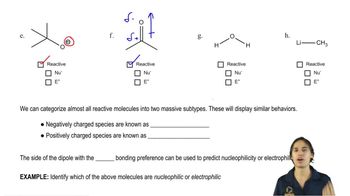
Reactivity of Molecules

Nucleophilic Aromatic Substitution

Nucleophilic aromatic substitution (NAS) is a reaction mechanism where a nucleophile replaces a leaving group on an aromatic ring. In this context, 1-naphthol can act as a nucleophile due to its hydroxyl group, which can attack an electrophilic center. This mechanism is crucial for understanding how the reaction proceeds to form the final product, Sevin® insecticide.
추천 영상:
01:47
Nucleophiles and Electrophiles can react in Substitution Reactions.

Formation of Carbamate

The formation of carbamates involves the reaction of an isocyanate with an alcohol or phenol, resulting in the creation of a carbamate functional group. In the synthesis of Sevin®, the reaction between methyl isocyanate and 1-naphthol leads to the formation of a carbamate, which is a key structural feature of many insecticides. Understanding this transformation is essential for proposing the overall reaction mechanism.
추천 영상:
02:26
Formation of Enolates