Ch. 21 - Carboxylic Acid Derivatives
Wade - Organic Chemistry 9th Edition
Wade9th EditionOrganic ChemistryISBN: 9780135213728당신이 사용하는 게 아니라요?교과서 변경
21장, 문제 48g

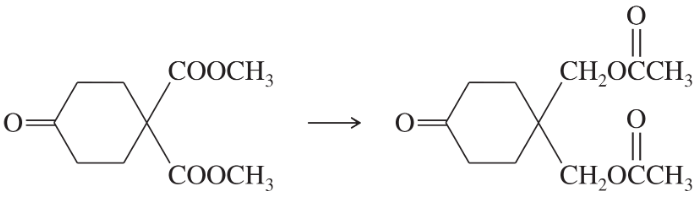
Show how you would accomplish the following syntheses in good yields.
(g)

검증된 단계별 안내
1
Step 1: Analyze the starting material and the product. The starting material is a cyclic ketone with two ester groups (-COOCH₃) attached to the alpha-carbon. The product has the same cyclic ketone structure, but the ester groups have been converted into beta-keto esters (-CH₂COCH₃). This suggests a transformation involving enolate chemistry.
Step 2: Recognize that the transformation likely involves a Claisen condensation. In this reaction, an ester reacts with a base to form an enolate, which then undergoes nucleophilic attack on another ester molecule, forming a beta-keto ester.
Step 3: Choose an appropriate base for the reaction. A strong base such as sodium ethoxide (NaOEt) or sodium methoxide (NaOMe) is commonly used for Claisen condensations. The base will deprotonate the alpha-hydrogen of the ester group, forming the enolate intermediate.
Step 4: Ensure the reaction conditions are suitable for Claisen condensation. The reaction should be carried out in an alcohol solvent (e.g., ethanol or methanol) that matches the alkoxide base used. After the reaction, an acid workup (e.g., H₃O⁺) is typically performed to neutralize the base and isolate the product.
Step 5: Verify the product structure. The Claisen condensation will result in the formation of the desired beta-keto ester groups (-CH₂COCH₃) on the alpha-carbon of the cyclic ketone. This matches the target product shown in the problem.

비슷한 문제에 대한 검증된 영상 답변:

이 영상 해법은 위 문제에 도움이 된다고 튜터들이 추천한 것입니다.
영상 길이:
6m

주요 개념

질문에 올바르게 답하기 위해 반드시 이해해야 하는 핵심 개념들은 다음과 같습니다.

Synthetic Pathways

Synthetic pathways refer to the series of chemical reactions and transformations that convert starting materials into desired products. Understanding these pathways is crucial for planning a synthesis, as it involves selecting appropriate reagents, conditions, and reaction mechanisms to achieve high yields and purity of the target compound.
추천 영상:
가이드 코스
2:13
Energy Production In Biochemical Pathways Concept 1

Reaction Mechanisms

Reaction mechanisms describe the step-by-step process by which reactants are converted into products, detailing the bond-breaking and bond-forming events. A solid grasp of mechanisms helps predict the outcomes of reactions, optimize conditions, and troubleshoot potential issues that may arise during synthesis.
추천 영상:
02:16
Heck Reaction Mechanism

Yield Optimization

Yield optimization involves strategies to maximize the amount of desired product obtained from a reaction. This includes adjusting reaction conditions such as temperature, concentration, and time, as well as employing techniques like purification and recycling of reagents to enhance overall efficiency and minimize waste.
추천 영상:
04:37
Draw all of the monochlorination products and calculate percentage yields.